


Life After the LLM: Katharina Hengst (LLM ’26)
Northwestern Pritzker Law’s international LLM program offers graduates of foreign law schools the opportunity to expand their knowledge of American law and legal processes, continue their studies ...
10.22.2026
After Law School Student Experience Alumni Tax Law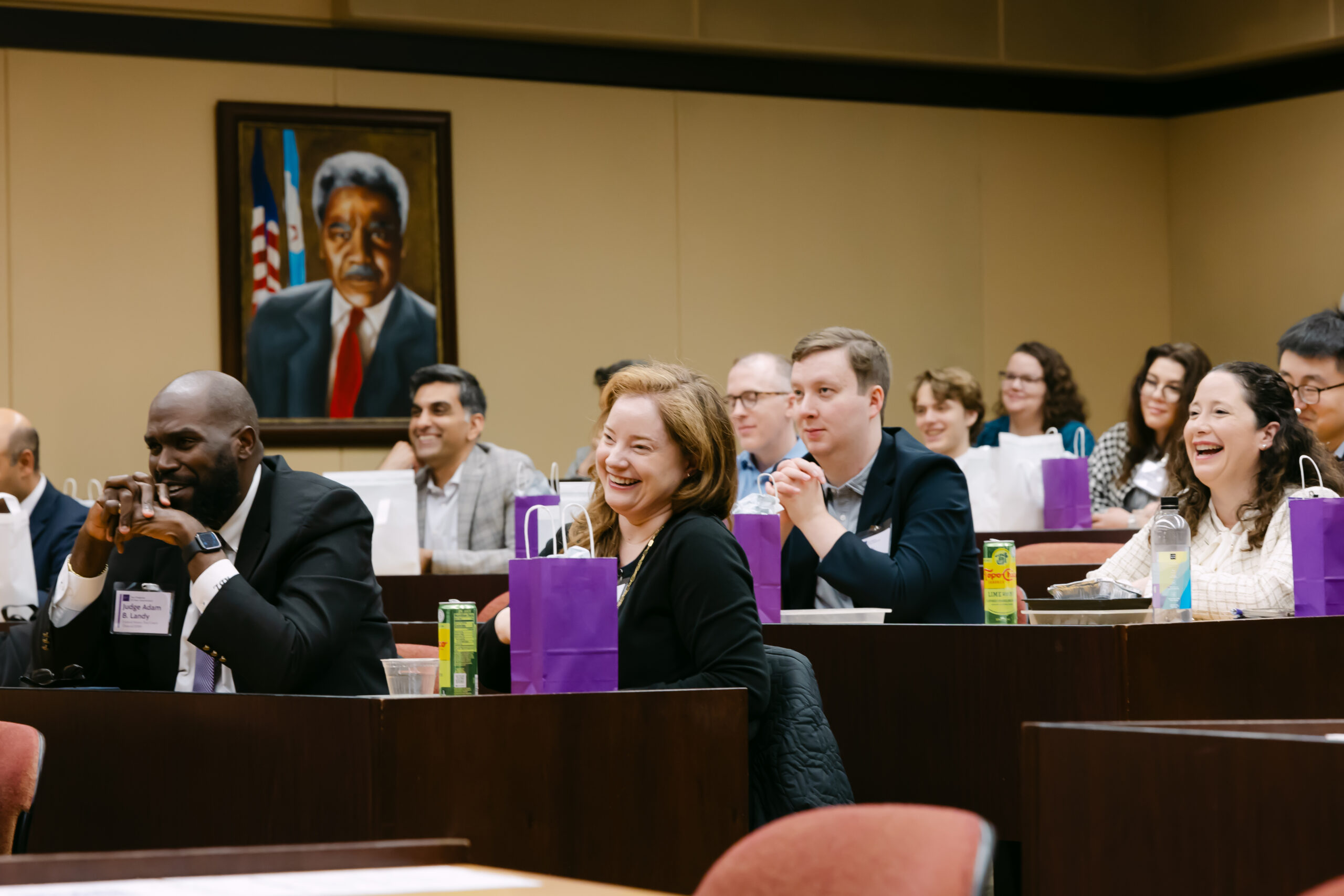
The 2026-2027 academic year marks an important milestone for Northwestern Pritzker Law’s Tax Program, as it officially celebrated its 25th anniversary with a series of events recognizing a quarter-century of lessons, growth, and change. Hosted at Reunion Weekend 2026, the Tax Program welcomed back alumni from all classes to join in the festivities, which included a speed networking session, ethics panel, and gala featuring keynote speaker United States Tax Court Judge Adam B. Landy (LLM ’10). “Even today, I continue to appreciate the strength of the Northwestern community and the lifelong connections it fosters,” said Judge Landy. “In addition to teaching me to think like a tax lawyer, the program introduced me to outstanding professors, mentors, and practitioners who generously shared their knowledge and experience.”
The reunion festivities reflect the success of what has grown to be one of the most renowned tax programs in the country. Its origins trace back to 2001, when Dean David Van Zandt suggested that Professor Philip Postlewaite build his own curriculum at the Law School. “It was a great opportunity, for the school and for Philip, to create a tax program that didn’t have any existing curriculum,” explained Professor Emeritus David Cameron (JD ’86), a former student of Postlewaite’s who became the Program’s first Associate Director. Of course, creating a program from scratch came with inherent challenges. “You’ve got to come out of nowhere amidst 29 other programs that were well established…it’s a high-risk opportunity,” Postlewaite said. The Program’s establishment faced an additional hurdle of circumstance in the fall of 2001, when the faculty approval vote was held only six weeks after 9/11. “There was a great deal of hesitancy and doubt, which was reflected in the vote…they approved us only provisionally for three years,” Postlewaite recalled, at which point it would be re-evaluated by the faculty. “Of course, I said, ‘bring it on.’”
With a small team made up of Postlewaite, Cameron, Janet Garesché (now Assistant Dean of Executive LLM and Tax Programs), and Professor Emerita Charlotte Crane, the Tax Program officially opened its doors in August 2002. Keeping the three-year provisional period in mind, Postlewaite worked with Cameron and Crane to bring in more adjunct faculty to teach courses and further develop the curriculum. When it came to adjunct recruitment, Cameron described the Law School’s Chicago location as a significant advantage. “There are so many great law and accounting firms in Chicago,” he said. “We were quite pleased and a little surprised at how enthusiastic professionals in these firms were when we approached them about teaching.”
Another crucial aspect of building out the Program was simply making its name known to potential students, both domestically and internationally. “We did a lot of travel to law schools to speak with students about the program,” said Cameron, who explained that an additional goal was to establish international academic connections with tax professors and lawyers outside the United States. According to Cameron, the “Northwestern name” also helped recruitment tremendously: “the quality of Northwestern’s JD program was so high that applicants and faculty were confident this was going to be a solid program.” And in the Program’s first decade, its “new kid on the block” status was itself an appeal to students such as Judge Landy. “There was something exciting about being part of something new!” he said.
It did not take long for the Program to hit a quantifiable milestone: between its second and third year, Northwestern Pritzker Law skyrocketed to the number 6 ranking in tax law by US News & World Report. “It was a shock beyond imagination,” said Postlewaite, who added that since that initial jump, the Law School has always been ranked number 4 or number 3 in tax law. “I personally am quite proud of that, because the other tax programs amongst the top four are all over 50 years old. NYU is turning 81. We covered a lot of ground in a short amount of time.”
Many factors have contributed to the Tax Program’s success. From the beginning, they sought to keep the class size small in comparison to other programs, with an average of about 35 to 45 full-time students. “When we recruit, oftentimes we say ‘First, the good news: we’ll get to know you. Now for the bad news: we’ll get to know you,’” joked Postlewaite. Professor Genevieve Tokíc (LLM ’12), an alumna and current Associate Director of the Tax Program, has experienced the personalized student-faculty relationship on both sides and views it as one of the most valuable aspects of the Program. “Students get to know faculty and faculty get to know them,” she said. “Whatever an individual person’s goals and interests are, we do what we can to help them get where they want to be.”
Each student has a dedicated faculty mentor, and students have access to a career advisor who works solely with Tax LLMs. “There’s this sense of community,” added Tokíc. “The students collaborate, they work together, they get to know each other. That was certainly my experience as a student.” These sentiments were echoed by Judge Landy, who said: “What I loved most was the culture of excellence combined with genuine support. There was an expectation that everyone would strive to perform at a high level, but there was also a sincere desire to see one another succeed. Faculty members were invested in students, and students supported one another.”
Another unique aspect of the Tax Program is its curriculum structure. Postlewaite structured the curriculum around four fundamental areas of tax law: property transactions, corporate taxation, partnership taxation, and international taxation. Students are required to take two courses in each area, which means eight out of the 12 classes needed for graduation are required. Having such a high ratio of required courses “isn’t for everyone,” said Tokíc, but it also distinguishes Northwestern Pritzker Law Tax LLM graduates when it comes to employment outcomes. “It gives us a lot of credence because employers know our students have taken corporate tax, international tax, partnership tax, and property transactions…all of our students have been exposed to all the fundamental areas of tax,” she said. “And it gives them a strong base of knowledge, as well as flexibility in terms of what they end up practicing in the world.”
All areas of the curriculum have been supported by renowned residential and adjunct faculty. As the program continued to grow in the late 2000s, Postlewaite focused on bringing in more residential faculty, seeking out some of the top tax practitioners in the country. “We hired some of the best in the world,” he said, including Robert R. Wooten, a prominent partner at Sidley Austin LLP and former Tax Legislative Counsel to the U.S. Treasury; Herbert N. Beller (JD ‘67), a partner at Eversheds Sutherland LLP and former chairperson of the ABA tax section; and Jeffrey T. Sheffield, who served on the management committee at Kirkland Ellis LLP. “All three of these people have national reputations.”
More recent residential faculty hires have included Ajay Mehrotra, Ari Glogower, Tokíc, and Paul Pencak, who transitioned from teaching as an adjunct to a Professor of Practice. And while the residential faculty roster might be the thing that has changed the most about the program over the last 25 years – with the COVID-19 pandemic ushering in a “wave of retirements” that saw the departure of Professors Crane, Cameron, Beller, and Sheffield – its high caliber has remained the same. “We’ve been so beyond fortunate in attracting the most extraordinary group of faculty members,” added Postlewaite. “Just a cut above, wonderfully decent human beings.” This includes the program’s 31 adjunct faculty members, whom Tokíc described as extraordinarily dedicated. “They also help students get jobs, give career advice, so that’s another great resource for the students,” she said. The Program’s staff members also provide crucial support, providing curricular advice and assistance navigating any personal challenges experienced along the way. Together, the faculty and staff make up “a really important piece of the experience for students,” said Tokíc. “They are part of what makes the Program so special.” Assistant Dean Janet Garesché, who has been with the program since the beginning, spoke of how special it has been to see students “come here to start their careers. It’s been wonderful to see everyone growing.”
In reflecting on the past 25 years, Postlewaite has commented on the Program’s consistency even amidst changes in faculty and, of course, the nation’s tax laws. “The law is changing, that’s part of the nature of the law of taxation,” he said. “But the flip side is, it’s always going to be there. Ben Franklin once said that two things in life are for certain: death and taxes. It’s omnipresent, people need it.” This consistency has contributed greatly to the continued success of its graduates during and after their time at Northwestern Pritzker Law.
The program’s future looks bright, with ever-expanding opportunities for incoming students—including a new scholarship established by Professor of Practice Emeritus Herb Beller to support students participating in Northwestern’s specially designed, in-depth JD-Tax LLM Joint Degree Program. “Aspiring tax professionals need high-quality, rigorous and practical educational training,” said Beller, “in order to understand and effectively advise clients on the vast array of technical and policy issues that regularly arise under our nation’s very complicated tax laws. Northwestern is especially well-equipped to provide this critical educational grounding, and I’m confident that the Law School will continue to attract and prepare high-quality students for productive careers as tax lawyers.” As alumni look back on the Tax Program’s success and celebrate its present, they can look forward to their ranks increasing with accomplished tax professionals for many years to come.
Northwestern Pritzker Law’s international LLM program offers graduates of foreign law schools the opportunity to expand their knowledge of American law and legal processes, continue their studies ...
Six recent Northwestern Pritzker School of Law graduates (all JD ’26) received post-graduate fellowships this year to support their work addressing issues such as environmental justice, education ...
Northwestern Pritzker Law’s international LLM program offers graduates of foreign law schools the opportunity to expand their knowledge of American law and legal processes, continue their studies ...