From students arguing cases before federal and state courts to faculty scholarship shaping opinions in the U.S. Supreme Court, from alumni arguing on behalf of the United States to judges returning to teach the next generation of lawyers, Northwestern Pritzker Law has had an extraordinary year of engagement with the nation’s courts.
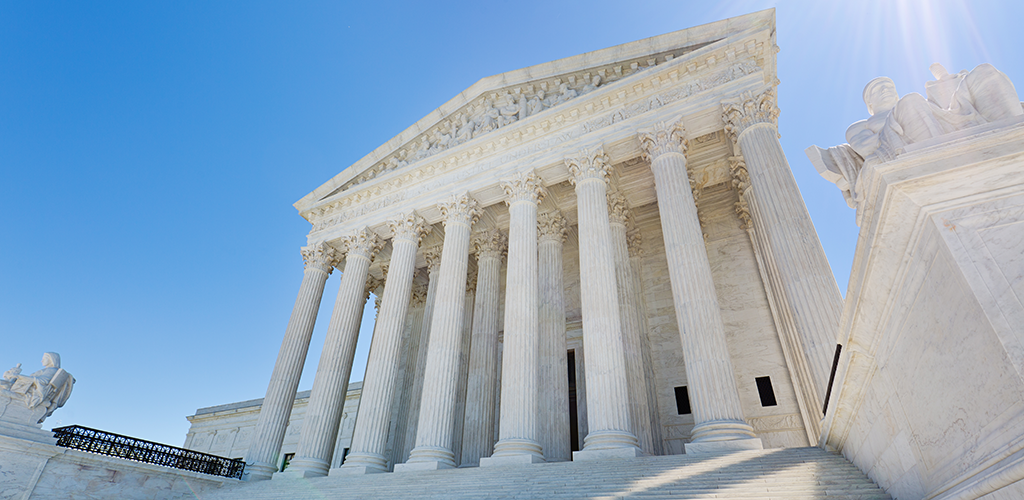
Through the Bluhm Legal Clinic, the Law School offers myriad opportunities for students to gain practical experience representing clients in court and participating in the judicial process while still in law school. Few experiences illustrate this better than the Carter G. Phillips Center for Supreme Court and Appellate Advocacy. Students in the Center’s Carter G. Phillips/Sidley Austin LLP Supreme Court Clinic work alongside faculty members to undertake research projects, including drafting briefs seeking a writ of certiorari, merits briefs, and amicus briefs, while learning how the Supreme Court functions. “When I first [started at] the Clinic, I didn’t really know the entire process, how the Supreme Court would actually hear a petition. To see that process go through…is really a holistic experience,” said Abhishek Chakrabarti (JD ’26). This past winter, the students paid a visit to the Supreme Court itself, where they had a chance to observe oral arguments for cases heard by the court. “It felt like a moment to connect what I learned from the clinic to how this delicate art actually plays out,” said Maple Zhang (JD ’26).
The Clinic also represented a client in a case heard by the Supreme Court. In Abouammo v. United States, the Supreme Court unanimously held that Ahmad Abouammo should not have been tried in a federal court in California for conduct that took place at his home in Seattle. “What makes the win especially meaningful is how the case reached the Clinic in the first place,” said Danielle Hamilton, Clinical Assistant Professor of Law and Director of the Carter G. Phillips Center. “A third-year student, monitoring Ninth Circuit decisions as part of the Clinic’s circuit-monitoring program, spotted the case as cert-worthy and reached out to Abouammo’s local counsel to partner on the case. That outreach led directly to the Clinic’s involvement, from cert petition through merits briefing.” The Clinic’s co-director, Tobias Loss-Eaton, argued the case in his first argument before the Supreme Court.
Northwestern Pritzker Law faculty are influencing the Supreme Court not only through advocacy, but also through scholarship that shapes judicial reasoning. Clayton J. and Henry R. Barber Professor Steven Calabresi, Owen L. Coon Professor Jim Pfander, and Clinical Professor Emeritus David Scheffer each had writings cited by Supreme Court Justices this term. Notably, Professor Pfander was cited in six separate cases, including a case in which he was cited both by the majority and dissenting opinions (Fernandez v. United States). Professor Pfander’s scholarship focuses on the role of the judicial systems in constitutional democracies; his most frequently cited work, the co-authored Hart & Wechsler’s The Federal Courts and the Federal System (8th ed. 2025), examines all elements of federal adjudication and devotes substantial attention to the role of the federal courts in ensuring government accountability.
Additionally, Dean Zachary Clopton continued in his role as a member of the Court’s Advisory Committee on Civil Rules, a role that helps shape the Federal Rules of Civil Procedure. The committee’s goal is to consider potential changes to the Federal Rules of Civil Procedure, research those proposals, and ultimately make a set of recommendations to the Supreme Court about any rule changes. The committee, largely composed of judges and lawyers from around the country, typically has one law professor as a voting member. The committee meets twice a year in person, primarily in Washington, D.C.
The Law School’s influence extends beyond its faculty and students. Alumni continue to have significant roles throughout the federal judiciary serving in prestigious fellowships, clerkships, and advocacy positions before the nation’s highest court. Alumna Keegan Coppola (JD ’24) just completed her term as a Supreme Court Fellow, a year-long program that offers law school graduates an opportunity to work for the judiciary “to broaden their understanding of the judicial system through exposure to federal court administration.”
As a Fellow, Coppola developed a research paper that focused on the intersection of federal criminal jurisdiction and sentencing policymaking, incorporating empirical findings from the FY2024 Sentencing Commission data. “I also attended private Sentencing Commission meetings, supported the 2025–2026 Sentencing Guidelines amendment cycle, and otherwise researched the practical and legal consequences of national policymaking,” she said. “This experience taught me about rulemaking, policy decisions, and administrative law.”
The program also offers multiple opportunities for Fellows to learn more about the courts, including gallery seating at Supreme Court oral argument and non-argument sessions, luncheon seminars sponsored by the Counselor to the Chief Justice, and meetings with various jurists and senior judicial administrators. “The Program welcomed me to spaces where decisions (and, often history) are in the making,” said Coppola, “from attending oral arguments at the Supreme Court, to the Sentencing Commission meetings up the street, all the way to the Committee on Defender Services of the Judiciary Committee in Colorado Springs. What a way to see the country!”
Like Coppola, alumnus Sopan Joshi (JD ’13) noted the opportunity to observe oral arguments at the Supreme Court as a crucial learning experience in his early career, when he clerked for Supreme Court Justices Alito and Scalia in 2015. “One of the best perks of clerking at the Court is the ability to attend every oral argument and learn from some of the best advocates in the country,” he said. A decade later, Joshi now works as Assistant to the Solicitor General, a position he has held since 2018, and argued three cases before the Supreme Court this past term on behalf of the Solicitor General. “The [Solicitor General’s] Office participates in most of the Court’s cases,” Joshi explained. “For instance, the government filed briefs and presented oral argument in 50 of the 58 cases that were argued this Term.” The cases that Joshi argued before the court this term were all “highly technical” cases involving jurisdiction of appellate courts, deregulation of the trucking industry, and immigration, respectively.
“Each was interesting in its own way, but what stood out to me was that the Justices were every bit as prepared and engaged in these cases as the ‘big’ cases, such as the ones on tariffs.” For Joshi, this sort of preparation and engagement on the justices’ part is what makes arguing before the Supreme Court most rewarding. “[I’m] getting to have a conversation with nine brilliant jurists…and because all of them have read the briefs carefully and are prepared with incisive questions to probe and test the limits of your position, the conversation is productive, interesting, and thrilling.”
The path to many of these distinguished careers begins with a judicial clerkship, a hallmark of Northwestern Pritzker Law’s postgraduate success. Before joining the Justice Department, Coppola and Joshi both clerked for judges in the lower courts, a role that Coppola says “was an invaluable entry point into legal practice.” This year, 68 graduates followed in their footsteps by clerking in the 2025-2026 term—the Law School’s second-best year for clerkships. About 85 percent of these are federal clerks, with graduates clerking in 25 states plus D.C. and the U.S. Virgin Islands, and the majority have a year or more of post-JD work experience. Former clerks continue to secure prestigious placements after their experiences, with last term’s clerks moving on to elite law firms, government fellowships, public defender and U.S. Attorney offices, and other public interest organizations. “Clerking is the rare, mutually fulfilling lawyering role: I was able to serve the public interest while learning more about the law and my role in it,” said Coppola. “Tackling different subject matters taught me a lot about what I want my career to look like and what types of cases I most enjoy working on, all on a faster timeline than might be possible in a more traditional lawyering role.”
For many alumni, clerkships become the foundation for careers on the bench. Many now serve as judges across the federal judiciary, including Judge Edmund Chang (JD ’94) of the Northern District of Illinois and Judge Michael Scudder (JD ’98) of the Seventh Circuit Court of Appeals. Judge Chang has hired multiple graduates of the Law School as clerks in his 15 years on the bench, sharing that he looks for clerks with a breadth of crucial traits, including learning new areas of the law quickly. “One of the wonders and certainly challenges of a clerkship is, you’re working for a judge who has all manner of cases,” especially in federal court, where civil and criminal are not divided, he said. “It’s anything Congress has thought of and decided to put inside the U.S. code, and anything the Illinois Assembly has thought of.”
Students at Northwestern Pritzker Law have multiple opportunities to learn these skills from judges directly, as many in the area teach classes at the Law School as adjunct faculty. Judge Chang has taught adjunct classes in the past, as has Judge Scudder, who also shared his insights as Convocation Speaker to the Class of 2025. Other adjunct faculty judges include Amy St. Eve of the Seventh Circuit; Robert Dow, Sunil Harjani (JD ’00), and Virginia Kendall of the Northern District of Illinois; and Abizer Zanzi of the Northern District of Indiana. Judge St. Eve received the 2026 award for Outstanding Adjunct Professor, a testament to the profound influence judges can have on students both in and out of the classroom.
Students also witnessed the appellate process firsthand when the Law School hosted a sitting of the Seventh Circuit Court of Appeals in the Thorne Auditorium. The three-judge panel heard oral arguments in six cases. All three judges had a connection to Northwestern Pritzker Law: Judges Scudder and St. Eve teach as adjunct faculty, and Judge Joshua P. Kolar (JD ’03) is an alumnus (as is Judge Scudder). Another alumnus, Brendan Duffy (JD ’17), argued a case at the sitting. Two additional sittings are scheduled for the fall semester.
Further opportunities for learning of the appellate process are available through the Carter G. Phillips Center for Supreme Court and Advocacy’s Federal Appellate Clinic, where students research, brief, and argue cases in federal appellate courts across the country. This year, students contributed to victories in three appeals, including a case that grew out of Center Director Danielle Hamilton’s final trial at a Chicago civil rights firm before joining Northwestern Pritzker Law. Hamilton was lead counsel in a wrongful death case following the 2018 fatal police shooting of Harith Augustus, a barber born and raised in the South Shore neighborhood in Chicago. During jury selection, the trial team raised a Batson challenge, arguing the defense had struck two Black jurors because of their race. The trial court denied the challenge, and the jury found in favor of the officer. Federal Appellate Practice Clinic students then contributed research supporting the motion for a new trial on appeal. In a rare outcome, the Illinois Appellate Court agreed the strikes were impermissibly race-based, remanding the case for a new trial.
Clinic students also contributed to two cases in the Seventh and Ninth Circuits, respectively, in which they briefed and orally argued before the court. In both cases, the court ruled in favor of the Clinic’s client. “Together, these cases gave CGP Center clinic students a broad and substantive slice of appellate practice, from circuit monitoring to briefing to oral argument on behalf of real people in cases with real stakes,” said Hamilton. “I couldn’t be prouder of our students for their excellent advocacy; all delivered before they’d even graduated from law school.”
Experiential learning opportunities such as these leave Northwestern Pritzker Law graduates uniquely positioned to embark on a successful career in the courts. “I’m especially grateful that Northwestern allowed me to combine traditional doctrinal coursework with practical experience, and I credit that for much of my career development,” said Coppola. She also points to the valuable collaborative skills gained while a student at the Law School, a sentiment echoed by Joshi.
“Northwestern has always inculcated a collaborative spirit among law students,” Joshi said, “and that community prepared me well for the similarly collaborative environment that is a hallmark of government work.” That community extends well beyond the Law School’s walls, forming a vibrant network of alumni around the world who take part in shaping legal doctrine through our nation’s courts. “The legal community is small,” said Coppola. “Even in D.C.—miles away from my home in Los Angeles and many of my law school friends in Chicago—I am grateful that many of my connections have rallied to support me. I am constantly amazed by the generosity of the Northwestern Pritzker Law community and grateful to be a part of it.”
On Friday, May 15, 2026, 518 graduates from 34 places around the world joined faculty, family, and friends for the Northwestern Pritzker School of Law’s 2026 convocation ceremony at the Chicago ...
Alvin Kruse (BA ’65, JD ’68) left Oklahoma and set out for Northwestern University in Evanston, Illinois, sight unseen. He enrolled as an undergraduate because of the scholarship that would ...
Northwestern University Provost Kathleen Hagerty announced on May 28 that Professor and Associate Dean Zachary D. Clopton will lead the Law School beginning July 22. Distinguished alumni, ...