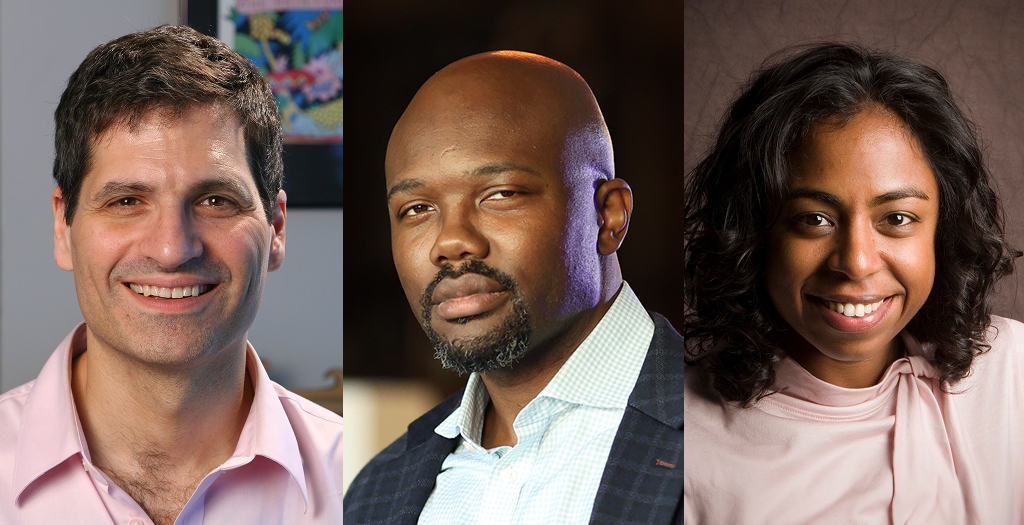
Professors David A. Dana, Chika O. Okafor, Myriam E. Gilles (l to r)
Northwestern Pritzker School of Law is home to an incredible group of faculty members working at the intersections of law and many other disciplines. Their research and scholarship has helped advance the understanding of law and legal institutions in a diverse array of fields. Learn more in our “Recent Faculty Works” series about the latest publications and innovations of our faculty.
By David A. Dana, Kirkland & Ellis Professor of Law, Professor of Real Estate, Kellogg School of Management (Courtesy)
Allocating financial responsibility for climate change costs to major energy companies could happen in many fora – at the federal, state or international level, via legislation, treaties or adjudication. This Article explores the allocation in the context of state law climate adaptation cost suits in the United States, and argues that a market share/several approach is tenable, although it raised complicated questions, most notably those surrounding wrongfulness. Of course, it is possible that legal institutions of all sorts ultimately will choose to focus solely on financial responsibility for harms associated with current or future emissions, or ignore corporate responsibility altogether. However, the airing of the issues discussed in this Article about harms from past emissions could also inform debates over responsibility for harms associated with current and future emissions. … Read More
Keywords: Climate Change, Adaptation, Market Share, Liability, environmental law, environmental law and policy, climate
By Chika O. Okafor, Assistant Professor of Law, Assistant Professor of Economics (courtesy), Assistant Professor of Management & Organizations (courtesy), Faculty Fellow, Institute for Policy Research
Why does racial inequality persist even when employers don’t discriminate? Professor Okafor identifies a mechanism hiding in plain sight: social networks. He originated the concept of “social network discrimination”—the phenomenon in which minorities receive systematically fewer opportunities simply because their group is smaller. When people naturally connect with others like themselves, members of larger groups enjoy more referrals, more resources, more access. Colorblind policies, however well-intentioned, reproduce inequality through network structure alone. This research challenges a core assumption in constitutional law: that ignoring race produces equal treatment. Professor Okafor’s research shows the opposite—colorblindness produces systematically unequal outcomes. Read More
Keywords: social networks, network structure, racial discrimination
Northwestern Public Law Research Paper No. 25-52 (2025)
By Myriam Gilles, Catharine Waugh McCulloch Professor of Law
The Supreme Court’s 2013 decision in American Express v. Italian Colors was widely seen as the death knell for the “effective vindication of rights” doctrine – a judicially-created rule that arbitration agreements are enforceable only “so long as the prospective litigant effectively may vindicate its statutory cause of action in the arbitral forum.” But reports of the doctrine’s demise were premature. This Article uncovers how, in the decade since Italian Colors, lower courts have quietly retooled the effective vindication doctrine, drawing on overlooked passages in Justice Scalia’s opinion that preserved challenges to arbitration clauses that prohibit the assertion of federal rights or render the arbitral forum practically inaccessible. These footholds are becoming foundations, as courts in recent years have invalidated arbitration terms that strip remedies, suppress injunctive relief, impose prohibitive costs, or distort procedural fairness in ways that frustrate Congress’s statutory design. Far from being a relic, effective vindication has reemerged as a potent, if underappreciated, constraint on arbitration’s expansion. Its quiet revival reveals a deeper judicial reckoning with the limits of privatization and signals the possibility of an arbitration jurisprudence that once again takes statutory enforcement seriously. … Read More
Keywords: Arbitration, ERISA, Mass Arbitration, Effective Vindication, Unconscionability
Emily Kadens, Edna B. and Ednyfed H. Williams Memorial Professor of Law, has been awarded a prestigious Visiting Fellowship for the 2026-2027 academic year at the University of Oxford’s All Souls ...
Robert (Bob) Burns, William W. Gurley Memorial Professor of Law Emeritus at Northwestern University Pritzker School of Law, has been awarded the American Bar Association’s (ABA) Tort, Trial, and ...
Civil procedure provides the backbone for how legal cases move forward, from when a case is first filed to the ultimate conclusion. It’s also a keystone of the research undertaken at Northwestern ...