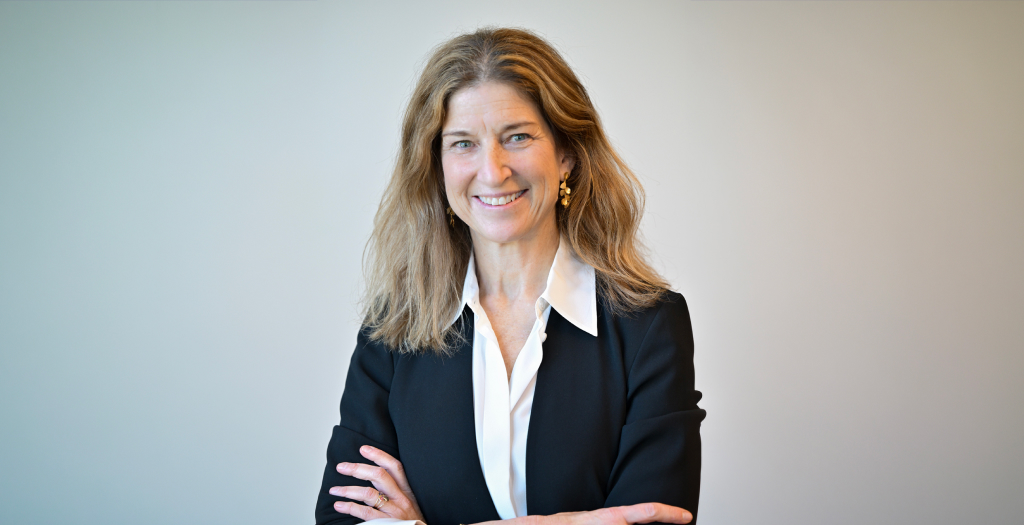
More than half of Northwestern Pritzker School of Law’s faculty hold PhDs in fields beyond law—making it one of the most interdisciplinary faculties in legal education. Few embody this interdisciplinary spirit more than Jill Horwitz, Trobman Innovation Professor of Law at Northwestern Pritzker Law and Professor of Emergency Medicine at Feinberg School of Medicine. A prolific legal scholar and policy expert, with a PhD in Health Policy in addition to a JD and Master of Public Policy, Horwitz is the first faculty member at Northwestern with a joint appointment at the Law School and Feinberg. “One of the reasons I wanted to come to Northwestern was the opportunity to work with nationally renowned health policy scholars and providers who work on the front lines,” she said. “Sharing the Chicago campus lets me actively learn from these providers and do the kind of practice-informed research that can make a difference.”
This sort of “practice-informed,” interdisciplinary research is crucial to Horwitz’s particular areas of expertise: contemporary healthcare policy and nonprofit law. In returning to Northwestern, where she received her undergraduate degree, she has found ample opportunities to collaborate across disciplines and institutions. With a rich body of work that includes published studies related to the opioid crisis, health insurance, and health care markets, Horwitz has already made great strides in her research while at Northwestern. “I care a lot about how regulation affects medical practice, [as well as] financing and structures related to the healthcare system,” she said. “But I can do much better work if I’m talking to practitioners…I’ve already learned so much about the kind of on-the-ground effects of regulation on medical practice, including the unintended effects, just by listening to my colleagues in the emergency department.”
This approach brings a fresh perspective to both her fellow scholars and students. At the Law School, Horwitz teaches “Health Law” and “Nonprofit Law and Policy,” both of which serve as introductory courses to these specialty fields. Her dual focus on health policy and nonprofit law dates back to some of her earliest research work, which focused on the care differences between nonprofit and for-profit hospitals. As that work continued, she began to take on other health subjects as well as non-health related nonprofit scholarship, leading her to develop two distinct areas of expertise, with different scholarly methods applied to each. “Half of what I do is contemporary health policy research, largely in the form of applied empirical economics;” she said. “This involves examining how regulation affects the patients, providers, and health systems. And the other half of what I do is nonprofit law, which is largely doctrinal and often historical.” Her work regarding nonprofit and for-profit hospitals has continued throughout her career, as it has remained an issue of continued debate among policymakers. Her input is highly valued among policymakers, and she testified before the U.S. House of Representatives’ oversight committee of ways and means in fall 2025.
Other recent publications have focused on matters such as private equity in healthcare, opioid prescription regulations, and how tort law affected nursing home patients and staffing patterns during the COVID-19 pandemic. Her research on all three matters is ongoing, with a continued focus on how regulation and state laws affect patient care. In particular, the regulations applied to nursing homes during and following COVID-19 offered researchers an opportunity to analyze regulation in a unique way. “During the pandemic, a large number of states, in a very uncoordinated way, granted immunity to nursing homes for negligent treatment of patients, providing exemptions from liability that would normally be addressed by the tort system,” Horwitz explained. Some states repealed the laws quickly, while others never repealed them, allowing her team of researchers to investigate the effects of tort laws on the medical system. “Oftentimes when you study the effects of tort law on provider behavior and outcomes, you don’t know whether it’s those laws that make a difference or whether there’s something else going on in the state,” she said. “But these laws were so rapidly and unsystematically adopted that it was easy to isolate the effects of the laws.” With the legal data collected by Horwitz and the research teams she works with, she is now studying whether immunity from liability affects the kinds of treatments and quality of care received by patients.
Outside of the health care field, Horwitz studies nonprofit law, largely focusing on state law. She is nationally recognized for her nonprofit work, having served as the Reporter for the American Law Institute Restatement of the Law, Charitable Nonprofit Organizations. In 2023, she received the American Bar Association Business Law Section’s award for Outstanding Nonprofit Lawyer, Academic, Nonprofit Organizations Committee. Her experience in this area has also garnered national attention in the media, when what she described as “the non-tax part of nonprofit law, state substantive nonprofit law, which is often considered a sleepy area” became the central focus in Elon Musk’s lawsuit against Sam Altman and OpenAI.
Horwitz first wrote about OpenAI in 2024, publishing an article with two colleagues in Tax Notes that described the unusual structure of the company following the ousting and reinstatement of CEO Altman. “OpenAI provides an interesting case for study because it is not a single company but, rather, it is a very complicated interlocking set of organizations and all of them ultimately are controlled by the purposes of a conventional nonprofit organization. In theory, that nonprofit should be one of the wealthiest in the world.”
Similarly, there were some notable aspects of the lawsuit Musk filed against Altman. “The court and the parties referred to Musk as a founding “trustee,” and used that status as a basis for standing,” Horwitz said. “But he wasn’t a trustee as the OpenAI nonprofit is a corporation, not a trust. And under law, being a founder of a nonprofit corporation does not typically lead to standing to complain about the nonprofit’s activities. Moreover, the fact that OpenAI had just signed an agreement with the Attorneys General of California and Delaware about many of the very issues in dispute was barely mentioned.” Throughout the lawsuit’s trial and in its aftermath, Horwitz served as an expert for members of the press, appearing on BBC, CNN, and NPR and quoted in numerous publications including The Wall Street Journal, Financial Times, and Wired. “Mainly I helped members of the press understand a fairly arcane area of law, and how that law was not being applied in an ordinary manner.” When the jury ultimately ruled against Musk for bringing his claims too late, Horwitz said that even though the substantive issues weren’t decided the trial likely brought increasing regulatory scrutiny to OpenAI regarding its handling of for-profit funds.
Between her work in nonprofit policy and healthcare policy, Horwitz often finds herself working on multiple projects at once. She credits her position at Northwestern with allowing her to continue this multiplicity of research, drawing connections across disciplines to answer critical questions. “Producing useful research on complex policy issues requires insights from many disciplines. This is why I like to work with teams of researchers, often including doctors who can explain which treatments make sense and which don’t and statisticians who can ensure that the models we apply do exactly what we intend.”
Horwitz also welcomes the opportunity to bring students into her research work, collaborating with them to refine the tools used to pull together legal databases. “Our students are so terrific, and I’ve been lucky enough to work with some great ones,” she said. “The legal dataset we are now assembling are so much better than what researchers have used in the past, largely because of the care used to research the state laws.” Meanwhile, within the classroom Horwitz makes sure to “always bring practicing lawyers in to talk with my students. It brings the subjects to life, often introducing students to new practice areas and giving them professional contacts.” She also welcomes the new perspectives that students bring to the material she teaches. “The students are inspiring. When I go into the classroom, I never know what new idea or perspective I’m going to hear. The students constantly change the way I think about the material, even material I’ve taught for many years.”
Whether with students or her fellow researchers, taking in different perspectives from a variety of areas has been a hallmark of Horwitz’s work. “A lot of the problems I work on and think about in health policy are really complex,” Horwitz said. “No single discipline can address them adequately. And what draws me to the field is the ability to work across all these different fields…working with a research team and learning from a statistician or a doctor or biologist.” Through her position at both the Law School and Feinberg, Horwitz is able to bring together scholars from across disciplines to address crucial issues in health care and nonprofit law.
With the 2026 midterm elections just weeks away, some of the rules governing those elections are still being contested in courtrooms across the country even though voters are already receiving ...
The animal rights movement brings moral clarity and emotional resonance to the debate over how and to what extent animals deserve legal protection in a variety of contexts, from the conditions of ...
Northwestern Pritzker School of Law is home to an incredible group of faculty members working at the intersections of law and many other disciplines. Their research and scholarship has helped ...