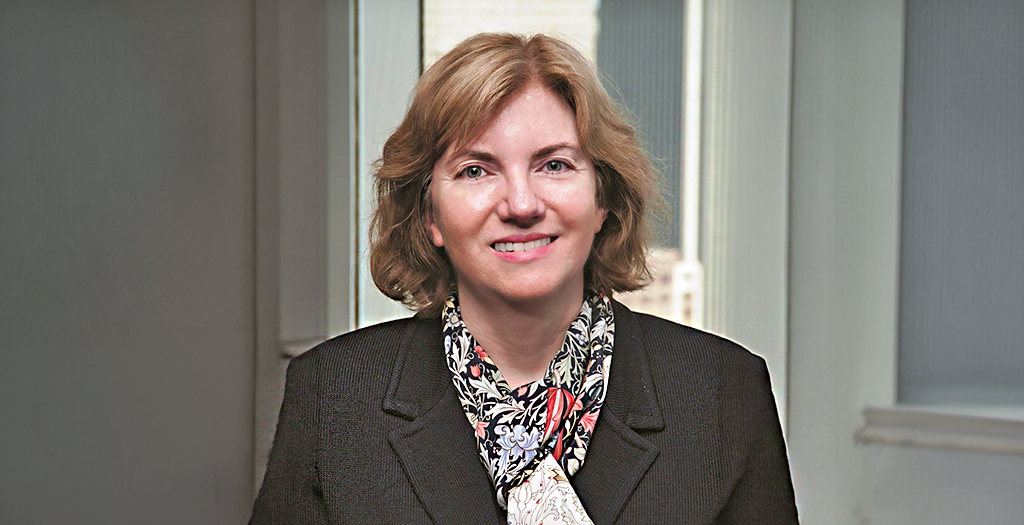
This fall, the Illinois Supreme Court Commission on Access to Justice (ATJ Commission) appointed Kathleen Dillon Narko, Clinical Professor of Law at Northwestern Pritzker Law, to the Commission’s Disability Access Committee. Formed in 2023, the Committee’s mission is to promote equal access to the court system for people with disabilities by identifying and addressing barriers to the court and legal process.
“I am honored to have the opportunity to contribute to the Committee’s work and to help advance access to justice for people with disabilities,” Narko said. “I am also pleased to represent Northwestern Pritzker Law through this service and bring insights from this work back to our students and community.”
Kathleen Dillon Narko joined the Northwestern Pritzker Law faculty in 1999. Prior to joining the faculty, she practiced with a large law firm concentrating in the areas of commercial litigation and environmental, safety, and health law. Professor Narko worked extensively with corporate clients in all aspects of litigation, including trials and appeals. She was also active in pro bono litigation, including lending discrimination and asylum matters. She currently consults with law firms, providing training in legal writing. At the Law School, Narko teaches Communication and Legal Reasoning, with a focus on teaching legal analysis through the vehicle of writing. “Teaching has played an important role in my career,” she said. “Teaching students how to communicate well, ethically and persuasively, affects success in all their classes.”
In 2025 she was named to the National Association of Women Lawyers’ Impact List, which recognizes mid-level and senior-level lawyers who have attained a high level of professional accomplishment and have demonstrated a personal commitment to women in the profession or advocated for women under the law. This recognition reflected Narko’s distinguished career, in which she has served not only as a teacher and lawyer but also as an advocate for others. She has been involved in disability advocacy for many years, serving with groups such as the City of Chicago Wheelchair Taxi Committee and Disability Lead, which promotes civic engagement among people with disabilities. At the Law School, she has acted as a valuable resource for students with disabilities, who will seek her out for advice as “someone else in the Law School who they can see with a disability.”
“Kathleen’s appointment is a well-deserved recognition of her accomplished career and her dedicated advocacy on behalf of people with disabilities,” said Zachary D. Clopton, Dean and Daniel Hale Williams Professor of Law. “We are fortunate that she brings the same commitment to the Law School, where her teaching and mentorship have made a lasting difference for our students and our community.”
Narko’s appointment to the Disability Access Committee represents an opportunity not only to share her legal expertise but also to continue her advocacy work in the court. “I’m gratified by being on the Committee in the first place, but what I’m most looking forward to is making an impact on a system I’m invested in,” she said. “It involves very hands-on, concrete changes to the way courts are run.”
These changes include addressing physical barriers to people using wheelchairs, such as smaller courtrooms in which getting through doors is difficult. “Every court in the state is required to assess people’s requests for accommodations,” Narko explained. “We will be fine-tuning that process.” The Committee is also examining at what point accommodations begin for individuals who interact with the court system. “Will they have ASL interpreters right at the beginning of the process? Will they be able to see courthouse signs if they’re low-vision?” These are just some of the questions the Committee is asking to create a more accessible experience for all.
Since beginning her service on the Committee, Narko has been “very impressed” by the work it has already accomplished, as well as the broad range of experience brought to the table by its members. “There are several members who, like me, have disabilities—a broad range of disabilities—and so we have many different perspectives from individuals’ lived experience.” The group includes lawyers, court administrators, and individuals who are not lawyers, which gives an additional perspective on the workings of the court system. “As lawyers, we get so used to how the courts function, that sometimes we lose perspective of an individual who has only had one or two interactions with the court system in their life,” said Narko. “And so we need to have that perspective.”
With the marked support of the Illinois Supreme Court, the Committee has made significant strides. The courts have a detailed policy in place that outlines processes for accommodations; the goal now is to make the policy as comprehensive and effective as possible. “The Supreme Court and the ATJ Commission are backing us up,” Narko said. “All citizens of Illinois should be glad that the Supreme Court is pursuing this goal. They understand that it is the right thing to do.” Through her service on the Disability Access Committee, Professor Narko will continue to work to refine the courts’ accommodations policy, increasing access to justice for people with disabilities in a way that benefits everyone.
With the 2026 midterm elections just weeks away, some of the rules governing those elections are still being contested in courtrooms across the country even though voters are already receiving ...
The animal rights movement brings moral clarity and emotional resonance to the debate over how and to what extent animals deserve legal protection in a variety of contexts, from the conditions of ...
Northwestern Pritzker School of Law is home to an incredible group of faculty members working at the intersections of law and many other disciplines. Their research and scholarship has helped ...