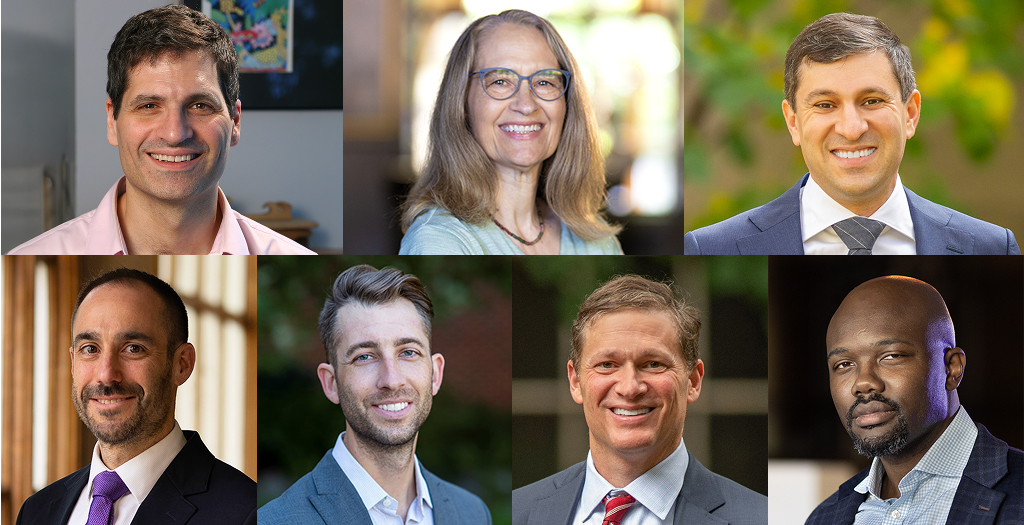
Top row: Professors David A. Dana, Janice Nadler, Ari Glogower (l to r). Bottom row: Dean Zachary D. Clopton, Empirical Fellow in Law and Computer Science Nathan Reitinger, Professors David L. Schwartz and Chika O. Okafor (l to r)
Northwestern Pritzker School of Law is home to an incredible group of faculty members working at the intersections of law and many other disciplines. Their research and scholarship has helped advance the understanding of law and legal institutions in a diverse array of fields. Learn more in our “Recent Faculty Works” series about the latest publications and innovations of our faculty.
By David A. Dana, Kirkland & Ellis Professor of Law, Professor of Real Estate, Kellogg School of Management (courtesy), Director, Program on Sustainability and Food and Animal Law; and Janice Nadler, Nathaniel A. Nathanson Professor of Law(co-authored with Justin Marceau, University of Denver)
Empirical Animal Law challenges long-held assumptions about what animal law reforms help or harm animals. Drawing on original empirical studies and a broad interdisciplinary body of research, the book tests whether familiar tools of advocacy such as incremental reforms, criminal prosecutions, litigation, and protest really reduce animal suffering. Moving beyond moral intuition and ideology the book reveals how people perceive animal harm, which messages and messengers persuade, and when well-intentioned strategies may backfire. With chapters on factory farming reforms, criminal punishment, litigation strategy, protest backlash, and moral framing, Empirical Animal Law offers the first comprehensive, data-driven account of how animal law operates in practice and calls for a new empirically informed movement. Learn more
Keywords: Animal Welfare, Animal Rights, Proposition 12, the Meat Paradox, Carceral Animal Law, Protest, Social Movements, Moral Psychology
103 Washington University Law Review 1867 (2026) By Ari Glogower, Professor of Law, Associate Dean of Academic Affairs (co-authored with Conor Clarke, Washington University in St. Louis)
American law is grappling with basic questions about the President’s power to impose tariffs—questions concerning whether Congress can delegate this authority, and the degree to which it has. But the ongoing tariff controversy emerges against a backdrop of conflicting and shifting historical practice. Early Congresses drafted tariff statutes in painstaking detail, while some of the broadest delegations in the early Republic involved internal taxes. In the modern era, by contrast, Congress has delegated more expansive tariff powers to the President, while retaining closer control over internal taxes. How should we understand this seemingly conflicting history of practice, and its relevance for the debates over tax delegation today? We begin by recounting the history of tariffs around the Founding, emphasizing the ways in which tariffs are historically and constitutionally distinct from other taxes. We then make three observations for the current debate over how nondelegation principles apply to tariffs. These points offer a consistent understanding of the early taxing power—and suggest why broad presidential tariffs conflict with constitutional structure and practice. Read More
Northwestern Law & Econ Research Paper No. 26-10, Northwestern Public Law Research Paper No. 26-29 (2026) By Zachary D. Clopton, Dean, Daniel Hale Williams Professor of Law; Nathan Reitinger, Empirical Fellow in Law and Computer Science; and David L. Schwartz, William G. and Virginia K. Karnes Research Professor of Law
If you believe what you read, contempt is a weapon for impetuous judges to punish parties for offending the judge or misbehaving in court. But this perception is built on a few headline-grabbing examples and reviews of published opinions. Relying on the largest document dataset ever compiled-every single document in every case filed in one year in a federal court-this Article finds that contempt is something completely different. Contempt on the ground is a tool wielded by parties in contentious cases as part of the larger strategic interaction of litigation. It is mostly related to discovery disputes, and it is mostly resolved without judicial intervention. Plaintiffs invoke contempt more than twice as often as defendants, and, in highly contentious cases, parties deploy repeat contempt motions as sustained strategic pressure rather than one-off remedies. These results have implications for the judiciary, for policymakers, and for scholars. Read More
Journal of Public Economics 262 (2026) By Chika O. Okafor, Assistant Professor of Law
Most criminal convictions in the United States never go to trial. More than 95 percent of felony convictions in state courts come from plea bargains, so the decisions that matter most—whom to charge, with what, and on what terms—rest largely with prosecutors, nearly all of whom are elected. This paper asks whether those decisions respond to politics. From 1986 to 2006, the height of the tough-on-crime era, prison admissions rose about 3 percent in the years district attorneys stood for election, roughly 63,000 additional admissions, and the effect faded as public support for harsher punishment declined. For legal education, the work shows that prosecutorial discretion responds not only to law and evidence but to the election calendar. For the legal field, it informs ongoing debates over how prosecutors should be chosen and held accountable, and it suggests that public opinion may matter as much to reform as changes to the law. Read More
In her new book, Sex and Sports: Transgender Rights and the Culture War Over Girls’ Sports, Kimberly A. Yuracko, the Judd and Mary Morris Leighton Professor of Law at Northwestern Pritzker ...
More than half of Northwestern Pritzker School of Law’s faculty hold PhDs in fields beyond law—making it one of the most interdisciplinary faculties in legal education. Few embody this ...
Northwestern Pritzker Law Professor David Schwartz combines an engineer’s interest in how systems work, a practicing lawyer’s knowledge of the legal system, and an empirical scholar’s focus on ...