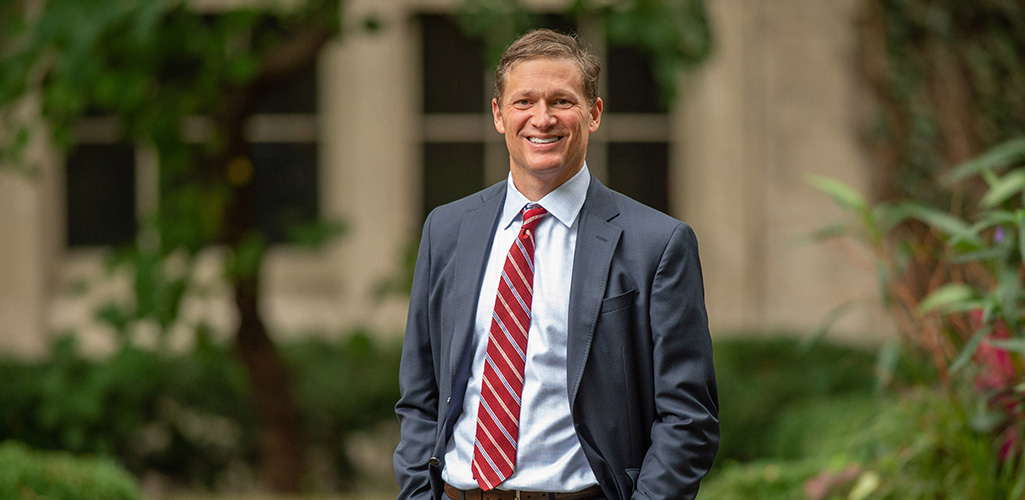
Northwestern Pritzker Law Professor David Schwartz combines an engineer’s interest in how systems work, a practicing lawyer’s knowledge of the legal system, and an empirical scholar’s focus on data. After earning a bachelor’s degree in chemical engineering before law school and spending 10 years in private practice, Schwartz has built a research agenda that spans patent law, federal court transparency, and the potential role of artificial intelligence in judging.
Schwartz, who served as associate dean of research & intellectual life at the Law School from 2019—22 and is now William G. and Virginia K. Karnes Research Professor of Law, says his research into patent law has gone in two main directions.
First, over the course of his career, he estimates one of his most significant contributions has been helping to bridge two traditions in patent scholarship: legal scholars with deep understanding of patent doctrine, litigation, and U.S. Patent and Trademark Office (USPTO) practice; and economists and business scholars with sophisticated empirical training.
“I saw those fields converging, and I think that they have converged more and more over time, and I try to put myself at the forefront of that convergence,” he says. “I’m somebody that practiced patent law for 10 years, so I have a lot of detailed understanding of how the patent litigation and patent office systems work, from on-the-ground experience. At the same time, I wanted to learn how economists approached questions using data and statistical methods. My work tries to combine these perspectives.”
The second strand of Schwartz’s patent-related research covers the use of data from the U.S. PTO to answer broader questions about the courts and decision-making by government offices. For example, he investigated how the Department of Government Efficiency (DOGE) led by Elon Musk in 2025 impacted employees at the USPTO, noting that government employee productivity is often difficult to observe, but that the USPTO publishes unusually detailed information about patent examination activities.
“We can use that information to study the effects of DOGE on what happens to government employees during periods of mass organizational disruption,” he says. “That’s not really a patent piece, although we used granular patent data as a window into how a federal agency responds to significant change.”
Another current article drew on a large body of PTO correspondence to determine when companies rely on inside versus outside counsel to handle various aspects of the patenting process, Schwartz says. “We used approximately a million patent applications to study a classic question in economics and organizational theory: when firms should perform work internally, and when should they outsource it? The project combined unique data with my knowledge of the patent system to shed light on that question.”
In addition to his patent-related research, Schwartz’s teaching focuses heavily on patent law, with both a doctrinal class and a seminar specifically on that topic, and another course on intellectual property law more generally. Before entering academia, he spent 10 years in private practice, including at Jenner & Block and two intellectual property boutique firms in Chicago. He joined Northwestern Pritzker Law in 2015 after teaching at Chicago-Kent School of Law and John Marshall Law School (now UIC Law).
Projects Beyond Patents
Although patent and intellectual property law remains his primary area of focus, Schwartz has also worked on projects involving the broader legal system. One example is SCALES OKN (Systematic Content Analysis of Litigation Events Open Knowledge Network), an NSF-funded collaboration with computer science and data science researchers that seeks to improve access to court records.
The SCALES project has focused on federal court records that researchers, journalists and members of the public have varying reasons for wanting to access, for which the government charges 10 cents per page—which can add up, depending on the volume needed, Schwartz says. “I knew this problem because I had been a lawyer for a long time, and I had done a lot of work in studying patent litigation,” he says. “I knew that it was really hard to get these underlying documents, and it was kind of inexplicable to me that they would charge money for it.”
The SCALES team assembled and standardized records from 94 federal district courts, creating a much more accessible resource for researchers, journalists, lawyers, and the public. The project also links court records with information about public companies, lawyers, law firms, and other entities, and this work has enabled new research on the court system. Schwartz notes that the project has supported research by his team and others, along with a symposium about opening up the court data system and promoting access to justice.
“We’re still advocating for more release of data, and Congress is considering what’s called the Open Courts Act, to require the federal courts to make the data freely available,” he says. “The mission hasn’t been completed. We continue to advocate for broader public access to federal court records.”
Schwartz also has begun studying the role artificial intelligence might play in legal decision-making, and he is helping lead discussions at both the Law School and university levels about AI’s implications for legal education and research.
Regarding the former, in one ongoing project, he is examining how well generative AI models can predict the outcomes of federal appellate cases. Rather than focusing on the philosophical question of whether judges must be human, Schwartz is interested in a more practical question: How accurately can AI systems evaluate legal disputes and predict case outcomes?
In the study, Schwartz and his collaborators provide AI models with the briefs and records from pending federal appellate cases and ask them both to predict the outcome and assess their confidence in their prediction.
While not all the cases in question have been decided to date, and data analysis on those that have is still ongoing, “the models are reasonably accurate, though not extraordinarily so,” he says. “What’s more interesting is that they appear to do a good job identifying when they are likely to be right and when they are likely to be wrong. When the model expresses high confidence, its predictions are often quite accurate. When confidence is low, accuracy tends to decline.”
The preliminary findings suggest that the debate over AI in judging may be overly simplistic, Schwartz says. “The question should not be whether AI replaces judges,” he says. “The more useful question is where AI performs well, where it performs poorly, and whether there are limited contexts in which it can assist human decision-makers. The conversation is likely to be more nuanced than a simple yes-or-no answer.”
Whether studying patent examination, federal court records, or AI systems, Schwartz’s work reflects a consistent interest in understanding how complex legal systems operate and how data can be used to improve them.
When Professor Myriam Gilles first began studying mandatory arbitration more than two decades ago, few people outside a small circle of legal scholars paid much attention. Today, she has become ...
Long before artificial intelligence became a defining topic in legal education, Northwestern Pritzker School of Law professor Emerson Tiller was asking a broader question: How should law schools ...
From law school in India to a Rhodes Scholarship in Oxford, from fellowships in South Africa and Germany to faculty positions at University of Minnesota Law School and the European University ...