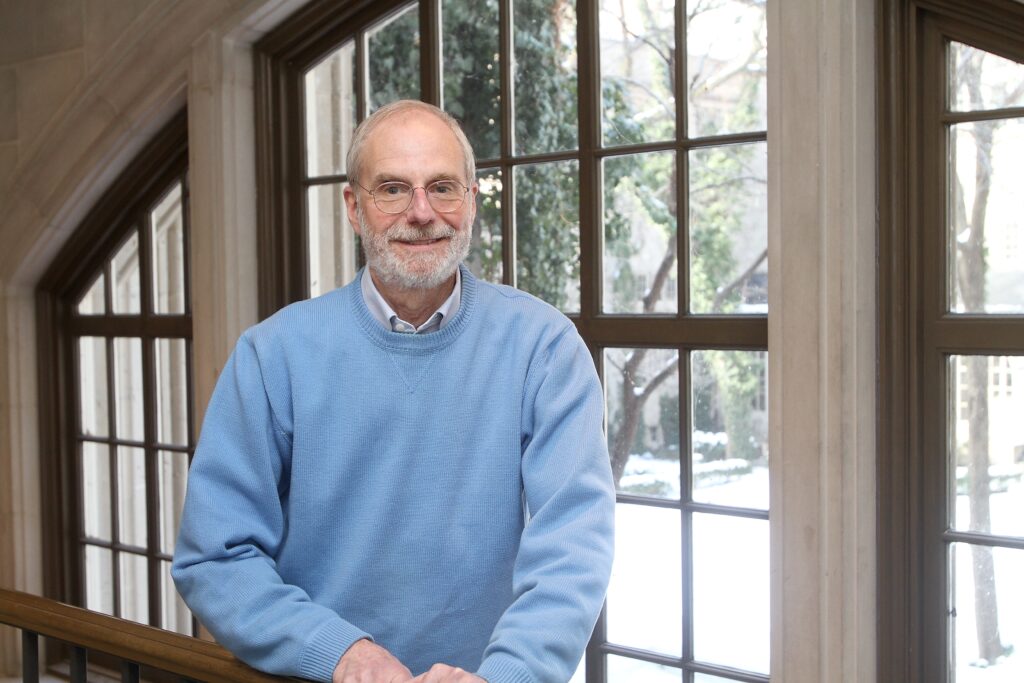
At Northwestern University Pritzker School of Law, Len Rubinowitz has spent more than five decades building a career defined by intellectual curiosity, public engagement, and an enduring commitment to his students. As he retires at the conclusion of this academic year, Rubinowitz leaves behind a legacy that spans civil rights scholarship, housing policy, and generations of lawyers shaped by his teaching.
Rubinowitz traces the origins of his academic career not to a single decisive moment, but to what he calls “serendipity.” In his third year at Yale Law School, he was a teaching assistant in a small, first-year course that introduced him to the possibilities of legal academia.
“There’s a lot of serendipity in all of this,” he said. “That experience got me thinking about law teaching as a possibility.”
After graduating, Rubinowitz pursued his early interest in housing and inequality through work at the U.S. Department of Housing and Urban Development, first in Washington, D.C. and then in Chicago, where he focused on issues affecting low-income communities and communities of color. His career soon led him to Northwestern, where he joined a research center on Evanston’s campus. In 1975, he transitioned to Northwestern Pritzker Law, beginning a tenure that would extend across generations of students.
His scholarship has centered on civil rights, housing, and the intersection of law and social science. Among his most influential works is Crossing the Class and Color Lines: From Public Housing to White Suburbia (2000), co-authored with James E. Rosenbaum, which examines mobility and inequality in American housing. His broader body of work explores the legal and social dimensions of race, public policy, and structural inequities.
Rubinowitz’s teaching has been equally impactful. His long-running course, Law and Social Change, became a cornerstone of the Northwestern Pritzker Law curriculum. Though the course predates his arrival—dating back to the 1950s—Rubinowitz made it his own after stepping in to teach it early in his career. Over time, it evolved into a distinctive, interdisciplinary offering.
“My class is a mixture of traditional law school courses with other parts to it,” he explained. “I think of it as having three parts: the lawyers’ strategy, the doctrine, and then the question of the impact of court decisions.”
That emphasis on real-world impact shaped the course’s focus on race, education, gender, and the limits of legal reform. For example, Rubinowitz incorporated works such as Gerald Rosenberg’s The Hollow Hope to help students critically assess whether courts can drive meaningful social change, encouraging them to look beyond doctrine to outcomes.
Rubinowitz’s engagement with urgent social issues extended beyond the classroom. In the early years of the AIDS epidemic, he worked on education and policy efforts aimed at reducing stigma and increasing public understanding. Collaborating with students, medical professionals, and law enforcement, he contributed to early initiatives focused on transmission, prevention, and public health education—work he undertook even before key aspects of the disease were widely understood.
Throughout his career, Rubinowitz has also pursued a sustained scholarly interest in the legal dimensions of the civil rights movement. His current book project examines the lawyers who served Martin Luther King, Jr. and the movements he led, seeking to fill what he describes as a significant gap in historical scholarship.
“It didn’t seem to me that there was very much written about the individual lawyers who served him and the movements he led,” he said.
The project builds on years of research, including a symposium and a major article published in 2016. Drawing on extensive archival materials—including thousands of pages of FBI transcripts—Rubinowitz aims to illuminate the collective legal efforts that supported the civil rights movement. Even in retirement, he plans to continue this work, noting that new materials and scholarship continue to emerge.
Despite his extensive academic contributions, Rubinowitz consistently returns to teaching as the most meaningful aspect of his career. He describes his classes—regardless of size—as seminars, emphasizing participation and intellectual risk-taking.
“I want there to be interaction. I want everyone to participate,” he said.
Many of his most rewarding moments, he noted, are small and personal: a hesitant student finding the confidence to speak, or a reluctant participant growing into a legal educator.
“Being a lawyer involves taking these kinds of risks,” he said, underscoring his belief that confidence and engagement are as critical as doctrinal mastery.
This commitment to student development will continue long past Len’s retirement. In honor of his lifelong commitment to public interest work, the Public Interest Center Fund has been established to strengthen the Center’s programming and expand opportunities for students pursuing careers in service. The fund will expand financial support for public interest students, increasing access and opportunity for students dedicated to public interest. The fund will also strengthen the Center’s programming, including career development resources, advising, and community-building initiatives that foster connection among public interest students and alumni.
As he transitions into emeritus status, Rubinowitz plans to remain active in research, advising, and scholarship, though he will be reducing his time teaching in the classroom as a colleague becomes the fifth professor to teach Law and Social Change. He looks forward to having more time for writing, as well as for family, while maintaining ties to the academic community.
Reflecting on his career, Rubinowitz remains characteristically modest. “Just how fortunate I have been, all the serendipity involved,” he said. “In short, it’s been a great gig.”
Even as he continues to be active in emeritus status, his formal departure marks the close of a significant chapter at Northwestern University Pritzker School of Law—one defined not only by scholarly achievement, but by a sustained commitment to understanding and advancing the role of law in social change, as well as the growth and success of his remarkable students.
Northwestern Pritzker School of Law is home to an incredible group of faculty members working at the intersections of law and many other disciplines. Their research and scholarship has helped ...
In her new book, Sex and Sports: Transgender Rights and the Culture War Over Girls’ Sports, Kimberly A. Yuracko, the Judd and Mary Morris Leighton Professor of Law at Northwestern Pritzker ...
More than half of Northwestern Pritzker School of Law’s faculty hold PhDs in fields beyond law—making it one of the most interdisciplinary faculties in legal education. Few embody this ...