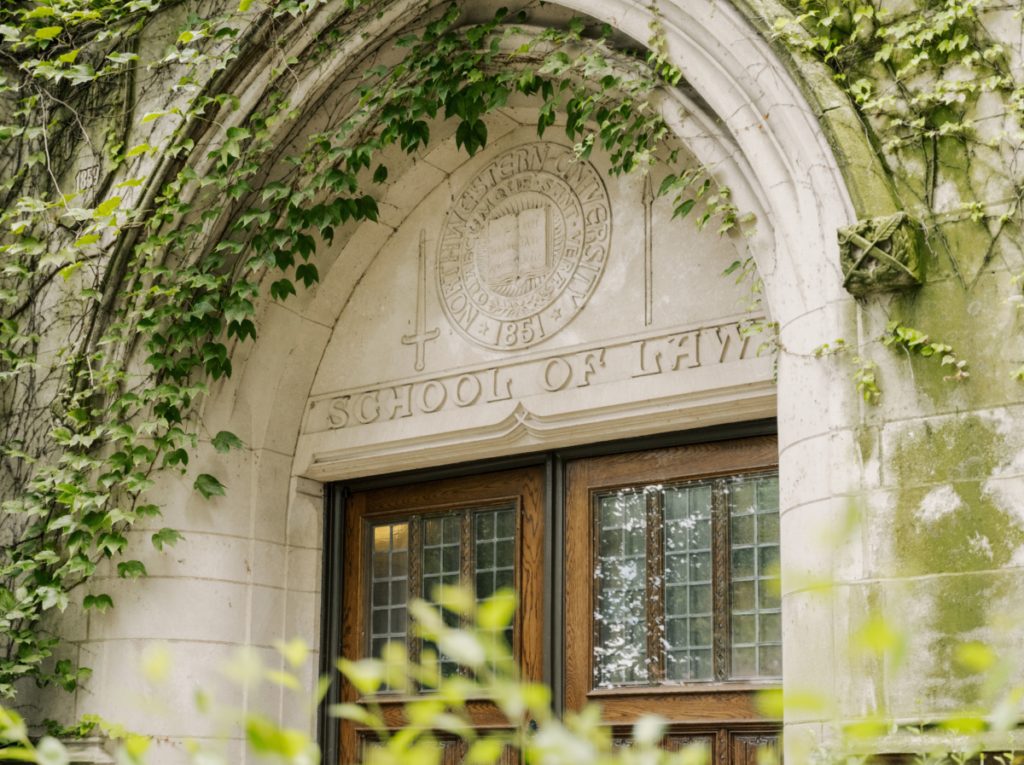
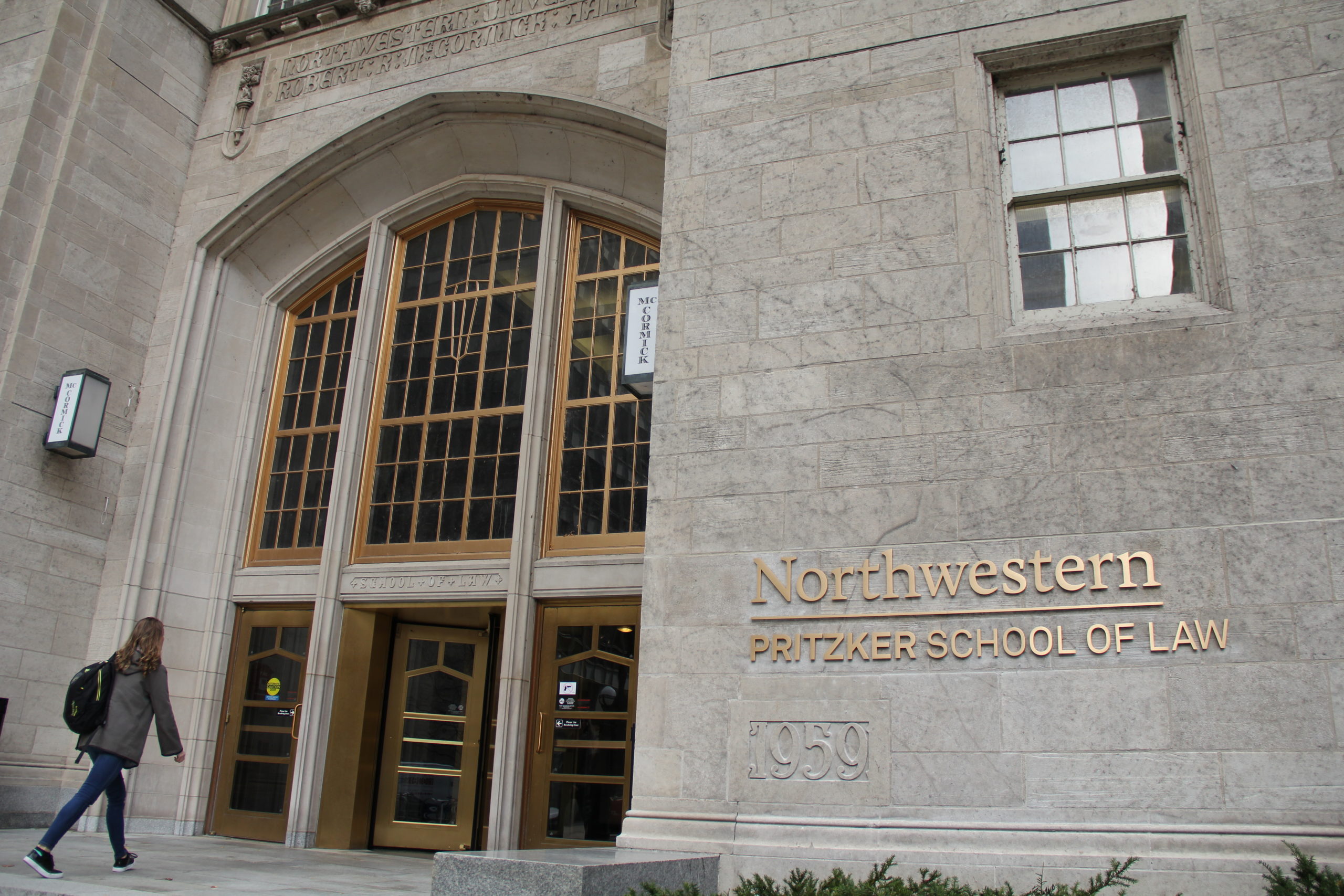
At Northwestern University Pritzker School of Law, the future of legal education is unfolding not only in appellate opinions and seminar discussions, but also in code repositories, sprint meetings, and prototype demonstrations.
The Innovation Lab, an interdisciplinary course jointly led by Daniel W. Linna Jr., senior lecturer and director of law and technology initiatives, and Kris Hammond, Bill and Cathy Osborn Professor of Computer Science at Northwestern’s McCormick School of Engineering, situates law students and computer scientists on the same teams to design and test technology-based solutions to contemporary legal problems.
The structure is deliberately immersive. This semester, 45 students—24 from the law school and 21 primarily computer science students—are divided into eight teams. Each team partners with an external stakeholder, which in past and present iterations have included judges, law firms, corporate legal departments, legal aid organizations, and companies such as Adobe and Thomson Reuters. Working in weekly sprints, students move from problem definition to prototyping, testing, and iteration, culminating in a public demonstration and question-and-answer session before a panel of experts.
“It’s an interdisciplinary class,” Linna says. “Students work across disciplines in their respective teams to develop prototype technologies, working with outside partners.”
Yet the course’s ambition extends beyond technical proficiency. It is equally concerned with pedagogy—how future lawyers and engineers learn to reason, collaborate, and exercise judgment in a landscape increasingly shaped by artificial intelligence.
“The big problems in the world, they’re interdisciplinary,” Linna says. “There are huge opportunities for AI to improve access to law, to improve courts, to improve rule of law and democracy. There’s also risks in the way we introduce AI into law, and this just cannot be accomplished with lawyers alone.”
Linna’s own trajectory reflects the convergence he now institutionalizes. Before attending law school, he worked as a software developer and information technology manager, designing systems and automating paper-based processes. He later clerked on the U.S. Court of Appeals for the Sixth Circuit, became an equity partner at a large law firm, and taught as an adjunct before entering academia full time. At Northwestern Pritzker Law, he holds a joint appointment bridging law and computer science.
“People would tell me, ‘Why are you doing this technology stuff? This is irrelevant to being a lawyer,’” Linna says. “It turns out it’s not.”
The projects undertaken in the Innovation Lab reflect that conviction. One team is collaborating with a federal district court judge in Texas to examine whether artificial intelligence tools can assist in reviewing high volumes of Social Security disability benefits appeals, with an eye toward increasing efficiency without compromising adjudicative quality. Another is working with the American Arbitration Association to design an AI-based mediation coach to guide self-represented parties through the complexities of settlement negotiation.
Linna himself is developing a moot court simulation tool that analyzes submitted briefs, generates questions, and attempts to emulate the reasoning patterns of a specific judge based on prior opinions. The aim is to foster the development of and expand human judgment, he emphasized, while augmenting preparation and deepening understanding for law students, practitioners, and potentially self-represented litigants.
While these projects bring innovation in courts and dispute resolution to the foreground, second-year law student Ana Carvalho is on a team that interrogates the epistemological foundations of AI in legal practice.
Carvalho’s group is partnering with Thomson Reuters to develop an evaluation framework for large language models (LLMs) such as ChatGPT, Claude, and Gemini. Their objective is not to enhance the models’ output, but to establish a structured, scalable method for assessing the quality of their legal reasoning.
“In law, an answer can sound persuasive and still be wrong, or incomplete, or poorly supported,” Carvalho says. “Those errors can carry real consequences.”
The team’s framework combines rubric-based scoring for benchmark-style questions, an “LLM-as-a-judge” approach for more open-ended tasks, and strategically limited review by human subject-matter experts. The central challenge, Carvalho noted, lies in articulating what constitutes “good” legal reasoning in a way that is sufficiently precise to be tested and replicated.
“The biggest challenge that I think every legal AI evaluator is facing is trying to define what ‘good’ means in a structured, testable way,” she says. “Lawyers will often disagree on what constitutes good legal reasoning versus bad legal reasoning.”
For Carvalho, the project has produced an unexpected pedagogical dividend. Translating intuitive doctrinal analysis into explicit evaluative criteria—correctness, completeness, issue coverage, citation validity, and calibrated expressions of uncertainty—has refined her own legal reasoning.
“In law school, you learn how to spot issues and argue,” she says. “But this project is forcing me to operationalize that instinct into something that I can score consistently.”
She now reports greater attentiveness to distinguishing rule statements from application, articulating assumptions, and avoiding overconfident conclusions—habits she believes will shape her professional practice.
“Lawyers who understand these tools, including their limitations and evaluation challenges, will be better positioned to use them in a way that’s both responsible and effective,” she says.
A defining feature of the Innovation Lab is its refusal to allow disciplinary silos. Although lawyers may lead on doctrinal questions and computer scientists on coding architecture, students are required to engage substantively with both domains.
“From the lawyer’s side, it can’t just be ‘the technology is magic,’” Linna says. “Lawyers must be able to converse with developers about data selection, system design, and functional limitations; engineers, in turn, must understand the normative stakes embedded in legal rules and institutional design.”
In that sense, the course reflects a broader reorientation within professional education. As artificial intelligence systems become embedded in legal research, drafting, and adjudication, the core competencies of both lawyers and software developers are being renegotiated. The Innovation Lab positions students at that intersection, asking them not merely to adapt to technological change, but to shape it.
The result is a classroom that treats legal services not only as doctrine to be mastered, but as products and processes to be designed, evaluated, and improved—a model of legal education that presumes the future of the profession will be co-authored by code and counsel alike.
Northwestern Pritzker School of Law Among Founding Members of Initiative Legora today announced the formal launch of the Legal AI Scholars Program, collaborating with leading law schools to ...
Three current online Master of Science in Law students share something in common: they are all 2011 graduates of the Kellogg–HKUST Executive MBA program, a partnership between the Kellogg School ...
The beginning of the academic year is always a time of great anticipation, for both students and faculty. That’s especially true for Distinguished Senior Lecturer Jeffrey Carter-Johnson as he ...