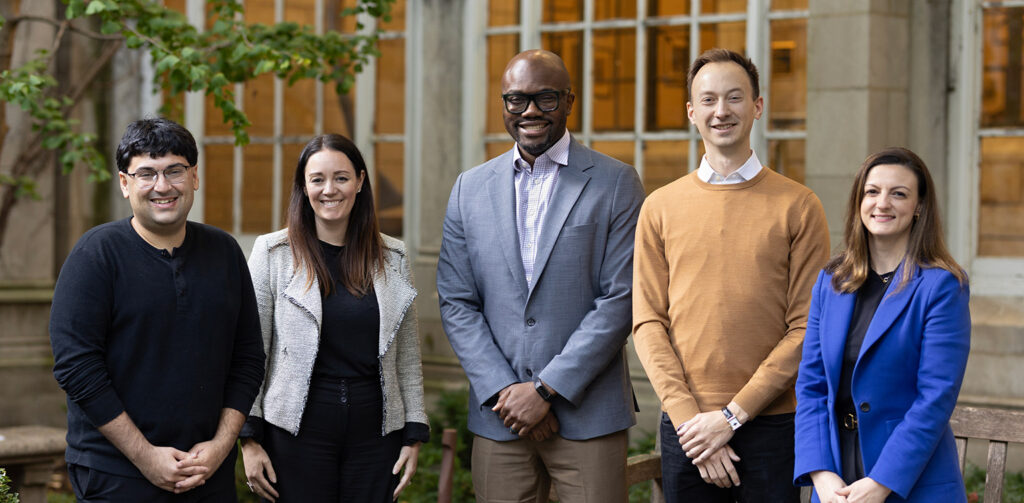
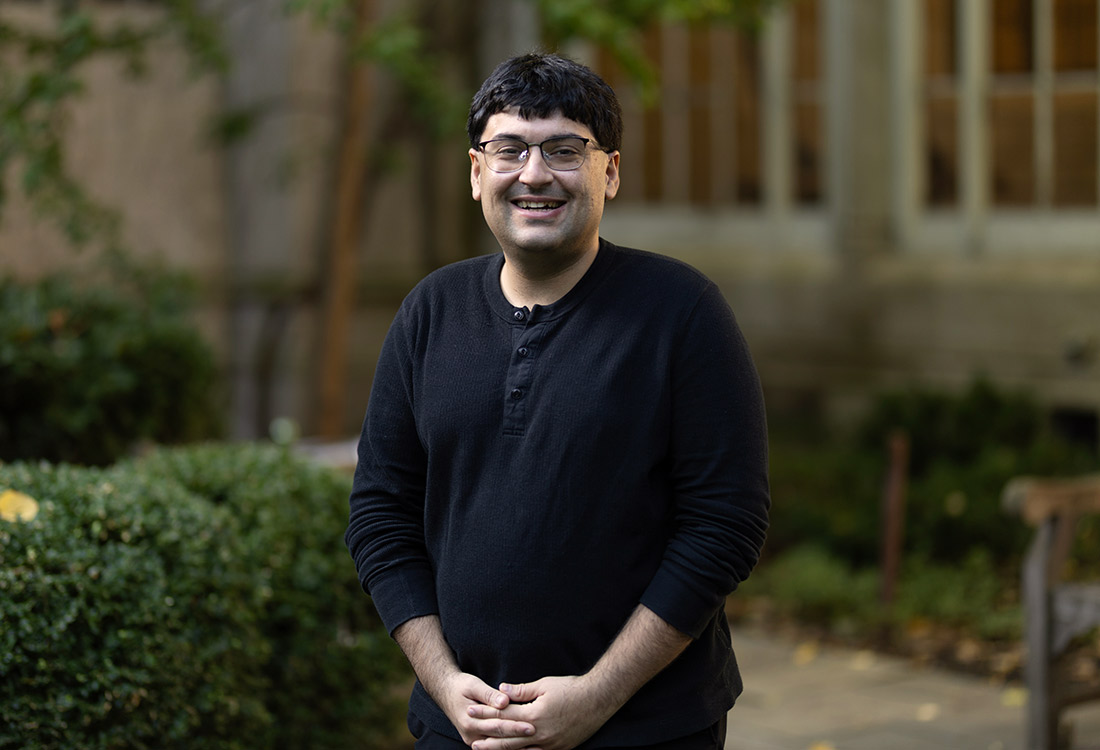
Pictured left to right: Dhruv Aggarwal, Stephanie Holmes Didwania, Chika Okafor, Drew McKinley, and Monica Haymond
At Northwestern Pritzker School of Law, a cohort of new faculty members exemplify a profound commitment to advancing legal scholarship while fostering a transformative educational environment. Their work largely reflects an intersection of rigorous research and a passion for pedagogy, both of which prepare students to navigate the complexities of the current legal landscape. This comprehensive exploration delves into each faculty member’s diverse scholarly interests, emphasizing their distinct areas of research focus and their teaching philosophy.
Research Forms a Pillar of Northwestern Pritzker Law
Interdisciplinary research is a key pillar of distinction at Northwestern Pritzker Law, where faculty members draw from various fields to address complex societal issues. This defining characteristic of Northwestern Pritzker Law is evident in the research of many new faculty members, who blend insights from law, economics, social sciences, and data analytics to create impactful scholarship.
Professor of Law Stephanie Holmes Didwania has an academic background in economics, one she applies to her scholarship on criminal law and criminal procedure. Armed with the analytical tools and empirical methods needed to investigate the complexities of the criminal system, Didwania has been able to successfully use data to answer questions related to the administration of the federal criminal system, including questions of fairness and equity in the system.
Given this background, Didwania notes her excitement to be part of an interdisciplinary-rich faculty at Northwestern Pritzker Law.
“I wouldn’t want to be on a faculty where everyone else who taught criminal law classes was also an economist. But that’s not how it is at Northwestern,” she says. “We have others who approach the field from all different ways. I think everyone’s work gets better when you can talk to someone who sees things differently or approaches a topic in a different way than you do.”
One of Didwania’s earliest projects uncovered the implications of pretrial detention on defendants’ criminal case outcomes. Her findings reveal that individuals who are detained prior to trial often face harsher penalties compared to those who are released, highlighting the cascading effects that early decisions in a criminal case can have on its ultimate outcome.
“I strive to create a classroom environment where students learn to think about the law with both the attentiveness necessary to be a skilled lawyer, and with the breadth to imagine how the law might be improved.”
– STEPHANIE HOLMES DIDWANIA
Other recent work highlights the complexities of asset forfeiture—a process through which law enforcement can take property believed to be connected to criminal activity. In her article published in the Stanford Law Review, Didwania addresses the lack of empirical research on asset forfeiture, utilizing a dataset from the Department of Justice that details all asset forfeitures conducted by the agency over the last two decades.
In her analysis, Didwania uncovers patterns in asset forfeiture practices, showing that the federal government is more active in conducting forfeitures that generate revenue in districts with lower white population shares, while the same is not true of forfeitures that do not generate revenue. Her work also reveals a notable concentration of these actions in regions near the U.S.-Mexico border. Her research brings to light the significant volume of forfeitures occurring in the United States, contributing to a broader understanding of how asset forfeiture is implemented across the country. The insights gleaned from this work not only enhance academic discussions but also inform policy debates surrounding law enforcement practices.
Looking ahead, Didwania is engaged in several early-stage projects that continue to explore critical issues within the criminal system. One such project investigates the relationship between federal prosecutors and their campaign contributions, aiming to assess how political affiliations may influence prosecutorial decision-making.
Another project focuses on the interplay between civil and criminal enforcement of immigration laws. Didwania examines how immigration offenses are prosecuted within the federal criminal system and explores the potential overlaps and distinctions between federal prosecutions and actions taken by agencies such as ICE.
Along with research, Didwania is deeply committed to teaching, believing it is essential to equip students with the skills needed to navigate the complexities of the criminal system. Her courses emphasize critical thinking and real-world applications.
“I find it incredibly rewarding to see students engage with the material and develop their analytical skills,” she says. “I strive to create a classroom environment where students learn to think about the law with both the attentiveness necessary to be a skilled lawyer, and with the breadth to imagine how the law might be improved.”
By integrating her research findings into her teaching, Didwania provides students with contemporary examples that illustrate the relevance of empirical methods in legal analysis. Her dedication to fostering a supportive and engaging learning environment inspires students to think critically about their roles as future attorneys.
She holds a BS in economics and mathematics and a JD from the University of Chicago, as well as a PhD in managerial economics and strategy from Northwestern University’s Kellogg School of Management. Prior to joining the Northwestern Pritzker Law faculty, Didwania taught at the University of Wisconsin Law School and Temple University Beasley School of Law. Her scholarship has been published in student-edited law journals, such as the Northwestern University Law Review and the Stanford Law Review, as well as peer-reviewed journals including the Journal of Law and Economics and the Journal of Legal Studies.
Assistant Professor of Law and Finance Dhruv Aggarwal combines his expertise in law and finance to analyze corporate governance and securities regulation. With a background that includes a BA in economics, a PhD in financial economics, and a JD from Yale University, Aggarwal’s interdisciplinary approach is rooted in a robust understanding of both legal principles and economic theory.
Aggarwal’s research examines the intricate relationship between large corporations and government entities, particularly in representative democracies. He investigates how political connections affect corporate behavior, specifically in the context of corporate social responsibility (CSR). One notable aspect of his research involves analyzing how politically dependent firms may treat CSR spending as a form of political donation, thereby influencing their contributions based on electoral cycles.
“My work emphasizes that corporate social responsibility is not merely about corporate altruism; it often intertwines with political motivations.”
– DHRUV AGGARWAL
“My work emphasizes that CSR is not merely about corporate altruism; it often intertwines with political motivations,” Aggarwal explains. “Understanding this relationship is crucial for both policymakers and corporate leaders.”
Along with his research, Aggarwal views teaching as a vital component of his academic role and is passionate about engaging students in the classroom. His teaching philosophy is centered on fostering critical thinking and encouraging discussions that connect theoretical concepts to real-world applications.
Aggarwal’s courses on business associations and securities regulation reflect his interdisciplinary approach. In both courses, he emphasizes the importance of understanding the economic context of legal rules. “Teaching provides an opportunity to distill complex ideas into accessible concepts for students,” he says. “I strive to create a classroom environment where students feel empowered to ask questions and challenge conventional wisdom.”
Aggarwal leverages his research to inform his teaching, using contemporary examples to illustrate the relevance of corporate law in today’s business landscape. His commitment to student engagement and interdisciplinary learning inspires future lawyers to think critically about their roles in shaping corporate governance.
“Through my teaching, I try to encourage students to analyze current events and case studies, bridging the gap between theory and practice,” he says.
Aggarwal’s own empirical studies shed light on the complexities of corporate governance and the ethical implications of corporate behavior within the political landscape. His findings are not only academically significant but also resonate with current debates surrounding corporate responsibility and political influence.
In one of his recent papers, Aggarwal examines the impact of electoral cycles on CSR spending in India. He finds that firms with political ties are more likely to increase their CSR contributions in the run-up to elections, suggesting that these contributions can function as a form of political advertising. This research highlights the need for regulatory frameworks that ensure transparency in corporate political spending and CSR practices.
Assistant Professor of Law Monica Haymond’s research examines how the rules of civil procedure influence the government’s exercise of authority. She explores how judicial discretion and strategic behavior by parties in litigation affect the outcome of civil cases, aiming to understand how procedural nuances shape access to justice and promote government accountability.
“I’m interested in how procedural rules can either empower or constrain parties within the legal system,” Haymond explains. “I want to know how those rules influence when people can enforce their rights or block the government from taking an unlawful action.”
In her recent project, Repeal by Surrender, Haymond explored the complexities of federal regulation and litigation, particularly how new administrations manage rules enacted by their predecessors. The project focuses on a legal remedy known as “vacatur,” a judicial order that nullifies a federal regulation so that it is no longer in effect. After a court vacates a regulation, an incoming president may decline to appeal that decision, effectively eliminating the regulation without engaging in the typically lengthy rulemaking process required to repeal. Several Supreme Court Justices have questioned whether this litigation strategy is legal and have even suggested that it might be a reason to limit when courts can vacate regulations. For Haymond, this poses a real concern.
“When a new president chooses not to appeal court decisions that vacate prior regulations, it can appear that they are using judicial outcomes to further their policy agenda,” she says. “But nothing in the law requires the government to appeal and defend a regulation the president no longer supports. At a time when the administration is testing the limits of lawful authority, courts should be cautious about restricting their remedial tools in the name of preventing harms that may not exist.”
By focusing on the intersection of procedure and substantive rights, Haymond’s work addresses critical questions about the effectiveness of the legal system in promoting equitable outcomes.
“Whether it’s two individuals suing over a broken contract or a blockbuster Supreme Court case to determine whether a law will apply to every person in the United States, the rules of civil procedure are supposed to be the same in those two cases,” Haymond elaborates. “But the context of the case ends up mattering a lot to how judges apply those rules and which substantive rights end up being protected in practice.”
In the classroom, Haymond is passionate about teaching civil procedure and federal courts. She emphasizes the importance of understanding how procedural rules operate within the legal system and influence the fairness of legal outcomes.
“Teaching civil procedure is particularly rewarding because it equips students with the analytical tools they need to navigate the legal system effectively.”
– MONICA HAYMOND
“Teaching civil procedure is particularly rewarding because it equips students with the analytical tools they need to navigate the legal system effectively,” she states. “I want my students to understand not only the rules, but also the broader implications of those rules for access to justice.”
By integrating contemporary examples and case studies into her teaching, Haymond helps students connect theoretical concepts to real-world applications. Her dedication to fostering critical engagement inspires students to think deeply about the relationship between procedure and substantive justice.
To further enhance students’ understanding, Haymond often uses examples from court proceedings to illustrate how procedural rules affect real cases. This approach allows students to see the relevance of procedural knowledge in practice, preparing them for their future roles in the legal profession.
Before joining the faculty in 2024, Haymond served as a Climenko Fellow and Lecturer on Law at Harvard Law School. She previously practiced as a managing associate in Orrick, Herrington & Sutcliffe LLP’s Supreme Court & Appellate Practice in Washington, D.C. and clerked for judges on the U.S. Court of Appeals. Her experiences in practice and academia inform her approach to teaching and scholarship.
Haymond earned her BA from the University of California, Davis, and her JD from the University of Virginia School of Law, where she developed a strong foundation in legal principles and analytical reasoning. Her scholarship has appeared in top law reviews, such as the University of Chicago Law Review and the Virginia Law Review.
The Intersection of Empirical Methods and Energy Law
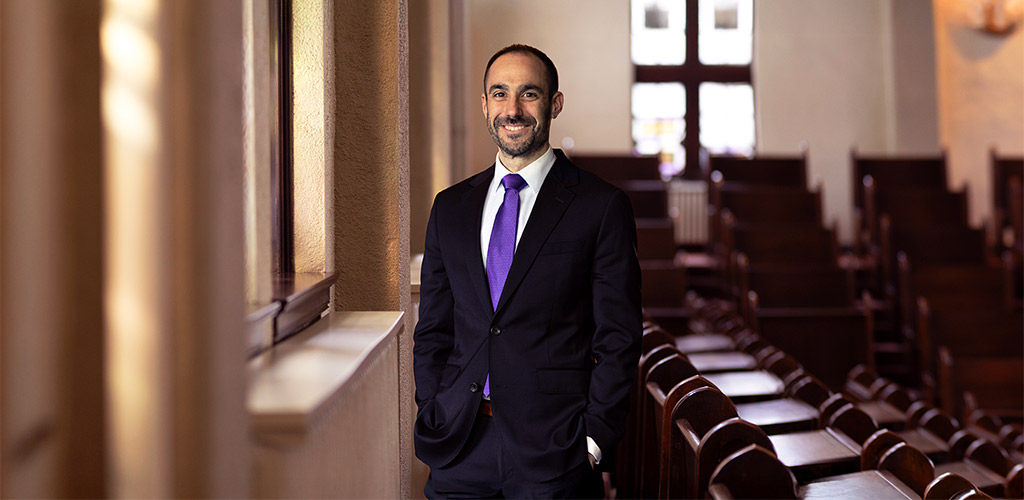
Drew McKinley
Prior to his academic career, Assistant Professor of Law Andrew (Drew) McKinley worked in finance, where he developed a keen interest in the intersection of economic forces and regulatory frameworks. His transition from finance to academia reflects a desire to explore the complex challenges posed by energy and environmental issues. McKinley’s research employs empirical methods and machine learning techniques to analyze how market forces influence energy regulation, allowing him to contribute to ongoing discussions about sustainability and environmental justice.
When it comes to the importance of interdisciplinary research in law, McKinley expresses incredible passion—which shows in his pedagogy as well.
“Our graduates will go on to undertake many policy-facing roles,” he says. “They’re going to be faced with a plethora of advocates from both sides. I think they need to have these interdisciplinary skills to assess the evidence in front of them and consider the policy choices they have in a very rigorous way.”
“Understanding the economic incentives behind regulatory decisions is essential for crafting effective environmental policies. My research seeks to quantify the trade-offs involved in regulatory approaches to energy production.”
– DREW MCKINLEY
McKinley’s teaching approach also emphasizes the importance of empirical analysis in understanding legal and regulatory challenges. He teaches courses on law and economics as well as business associations, where he integrates insights from his research into the curriculum.
“I strive to engage students in discussions about the real-world implications of legal decisions, particularly in the context of energy and environmental law,” McKinley states. “My goal is to help students see the connections between law, economics, and public policy.”
To enhance student learning, McKinley often incorporates data analysis projects into his courses, allowing students to apply empirical methods to real-world legal issues. This hands-on approach not only deepens students’ understanding of the material but also equips them with valuable skills for their future careers.
By fostering an interactive and dynamic learning environment, McKinley encourages students to think critically about the implications of legal decisions in the context of energy and environmental law. His dedication to teaching inspires students to consider the broader implications of their work in the legal field.
As for his own research, one of McKinley’s most significant research projects examines the implications of regulatory grandfathering—where existing firms are exempt from new regulations—and its impact on environmental outcomes. His current study focuses on the debate surrounding grandfathering in the legal context of coal power plants. The paper examines whether existing plants should be exempt from new regulations, highlighting the drawbacks of grandfathering, and showing that the Clean Air Act affords a less environmentally damaging way to grandfather.
“One significant concern is that allowing older, polluting plants to continue operating can perpetuate environmental damage and reduce incentives for investment in cleaner technologies,” he says. “The research investigates the trade-off between the benefits of grandfathering and the potential increase in emissions when firms push their plants to operate more frequently before they are forced to retire.”
McKinley references findings related to the Clean Power Plan, noting that coal plant operators increased CO2 emissions and PM2.5 concentrations during the plan’s brief several-month implementation period prior to the Supreme Court halting the plan in February 2016. The increased CO2 emissions and PM2.5 concentrations resulted in annual damages estimated at around $20 billion, which contrasts sharply with the projected social benefits of the Clean Power Plan.
“Understanding the economic incentives behind regulatory decisions is essential for crafting effective environmental policies,” McKinley explains. “My research seeks to quantify the trade-offs involved in regulatory approaches to energy production.”
McKinley’s current work also addresses the commitments made by firms to reduce flaring of natural gas, a wasteful practice that contributes to greenhouse gas emissions. He analyzes data from companies that have pledged to end flaring by 2030, assessing the effectiveness of these commitments and their real-world impacts on emissions.
In addition to serving as assistant professor of law at the Law School, McKinley holds a courtesy appointment at Northwestern University’s Kellogg School of Management. His academic background combines a PhD in managerial economics and strategy from the University of Chicago Booth School of Business with a JD from Stanford Law School.
Assistant Professor of Law Chika Okafor also joined the Law School faculty in 2025, bringing with him a wealth of experience in law, economics, and public service. As a graduate of the Chicago Public Schools for elementary through high school, Okafor’s path to academia was shaped by the very community Northwestern serves. This path has included significant leadership across both the private and public sectors. Before entering academia, Okafor worked as a management consultant with McKinsey & Company and as a corporate attorney in the London office of Skadden, where he developed a keen understanding of how legal frameworks interact with economic forces. Within public service, Okafor has worked on violence prevention with the Chicago Public Schools, genocide prevention with the U.S. Holocaust Memorial Museum, and economic and regulatory policy in the White House. These experiences inform his research interests and teaching philosophy, both of which align with Northwestern Pritzker Law’s strong interdisciplinary component.
“Northwestern’s commitment to interdisciplinary work and practical impact aligns with what informs my work,” he says. “I can collaborate across law, economics, and policy while staying grounded in questions that matter for justice and positive social impact.”
Okafor’s scholarship integrates economic theory with empirical methods to address pressing societal issues, including economic inequality, historic incarceration levels, and climate change. He is particularly interested in how legal institutions and social networks affect these major economic and social problems.
“My goal is to integrate the tools of law and economics to create a more just society,” Okafor states. “I want my research to improve both policy decisions and individual lives.”
In the classroom, Okafor is committed to fostering an inclusive and engaging learning environment. He teaches courses on constitutional law and climate and energy law, where he encourages students to think critically about the complex intersections of law, economics, and public policy.
“I seek to empower my students to see the law as more than just an academic discipline or intellectual exercise, but as a tool for societal progress.”
– CHIKA OKAFOR
“I seek to empower my students to see the law as more than just an academic discipline or intellectual exercise, but as a tool for societal progress,” he says. “By integrating real-world examples and current events into my teaching, I help students understand the impact of their future work as legal professionals.”
Okafor’s research also reflects his commitment to addressing real-world problems with interdisciplinary scholarship. “I use large-scale administrative data, rigorous empirical methods, economic theory, and legal analysis to examine questions that matter for people’s everyday lives—not just academic debates,” he says. “Whether it’s how prosecutor elections affect sentencing or how social networks perpetuate discrimination, I’m asking: What does this mean for real communities?”
In one of his notable projects, Okafor originated the concept of “social network discrimination” in the peer-reviewed Journal of Law and Economics. This research mathematically proves how colorblind policies perpetuate inequality even in the absence of psychological bias. Featured on NPR’s All Things Considered, Okafor’s findings demonstrate that group size alone disadvantages minorities, even when everyone starts off with equal qualifications.
“The research uncovers what many have long experienced,” Okafor explains. “Systems that appear neutral still produce profoundly unequal outcomes.”
In his ongoing work on the historic levels of incarceration, Okafor examines the role of prosecutors and their electoral incentives in shaping sentencing outcomes. His research provides evidence that political considerations influence prosecutorial discretion, contributing to sentencing disparities. This research suggests that reducing historic levels of incarceration requires not just technocratic policy interventions but also shifts in public opinion and collective approaches to criminal justice.
Okafor’s research has been published in leading academic journals and media outlets such as the Chicago Tribune. His public writing, including op-eds in the Boston Globe and Newsweek, translates complex concepts into accessible analysis of pressing social issues. In addition to his faculty appointment in Northwestern Pritzker Law, he holds dual courtesy appointments in the Economics Department and in the Kellogg School of Management. He also serves as a faculty fellow at the University’s Institute for Policy Research. Okafor earned his PhD and MA in economics from Harvard University, his JD from Yale Law School, and his BA from Stanford University.
Representing a wealth of different backgrounds and research topics, new faculty members at Northwestern Pritzker Law exemplify the transformative power of legal research combined with a passion for teaching. By bridging insights from law, economics, and social sciences, they tackle complex societal issues while fostering an engaging learning environment for their students.
Their commitment to both scholarship and education not only enriches their own work but also prepares the next generation of legal professionals to navigate an increasingly interconnected world with depth and understanding. As these faculty members continue to pursue their research and teaching endeavors, they embody the spirit of collaboration and innovation that defines Northwestern Pritzker Law.
Northwestern Pritzker School of Law is home to an incredible group of faculty members working at the intersections of law and many other disciplines. Their research and scholarship has helped ...
He has served the school as interim dean for the past six months Daniel Hale Williams Professor of Law Zachary D. Clopton has been appointed dean of Northwestern Pritzker School of Law, ...
Emily Kadens, Edna B. and Ednyfed H. Williams Memorial Professor of Law, has been awarded a prestigious Visiting Fellowship for the 2026-2027 academic year at the University of Oxford’s All Souls ...