Northwestern Pritzker Law has a long history of fostering a commitment to pro bono and public service in its students and graduates, offering myriad opportunities to serve and give back. Acknowledging that not all students will pursue public interest careers, students are offered a wide variety of opportunities to gain practical skills while bringing life-changing services to underserved communities. One such opportunity provides students a full week of immersive, experiential learning and service to communities outside the Chicago area. Dubbed Alternative Spring Break, this long-standing program is facilitated by the Public Interest Center but led by students themselves, offering valuable leadership and collaboration opportunities in addition to their pro bono service.
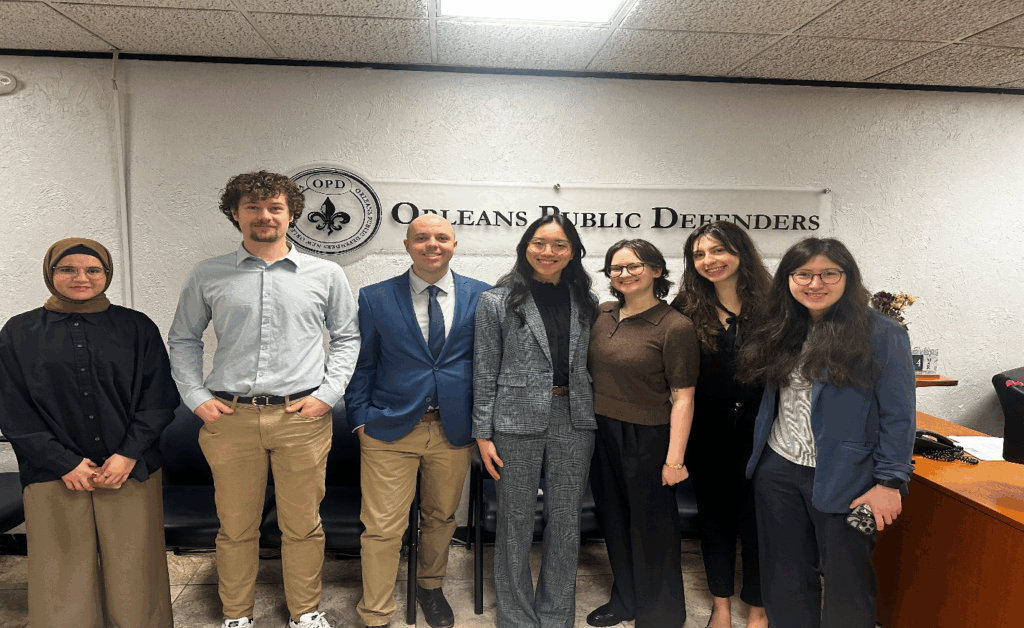
With the program in place for more than a decade, the Law School usually sends about a dozen students to two different destinations. It has a longstanding relationship with one of this year’s partner organizations, the Orleans Public Defenders office, in New Orleans, Louisiana, and has sent students there for the last several years. The other organization, Legal Action of Wisconsin in Milwaukee, Wisconsin, was selected to allow students to engage in civil legal services in the Midwest.
Most of the students who sign up for the trip are 1Ls, and the trip offers an opportunity for immersive experiential learning amidst the foundational courses covered in the first year of law school. “I think there’s a lot of staccato rhythm to the pro bono work you do as a 1L,” explained Aiden West (JD ’28). “So, it’s nice to just dedicate a week, five days straight, to get meaningfully involved now that you’ve had some law school under your belt. I thought it’d be a great opportunity.” Similarly, Michelle Lee (JD ’28), student leader of the Wisconsin trip, wanted to both “gain intensive hands-on pro bono legal work experience and utilize my time over the spring break to serve under resourced communities,” developing her own skills while making meaningful contributions.
For Amelia Luo (JD ’27), a 2L who served as student leader of the New Orleans trip, Alternative Spring Break presented an opportunity to witness a different type of law than what they had been exposed to in prior internships and volunteer work. “The job opportunities I’ve had have mostly been on the civil side,” they said. “I feel like I wouldn’t have an opportunity where I can work in a public defender’s office. My friend had a wonderful time working at the Chicago public defender’s office, and he really recommended the experience at any public defender.”
While in New Orleans, the students aided in a wide range of work, including meeting clients and gathering information for hearings, reviewing bodycam evidence, and observing a jury trial that ran throughout the week. Both Aiden and Amelia noted that observing the jury trial was particularly valuable.
“For a lot of us 1Ls, the number of sidebars and objections you’re seeing – the pace of the trial was pretty surprising,” said Aiden. Amelia added that the differences between Illinois and Louisiana state laws were somewhat unexpected: “I was surprised by some of the legal rules there. Louisiana still has cash bond, and in jury trials you can’t take evidence back to the jury deliberation room, unlike in Illinois.”
Meanwhile, the students who traveled to Milwaukee assisted the attorneys of Legal Action of Wisconsin, focusing primarily on two projects: the Eviction Defense Project, and the Consumer Debt Collection Project. This included assisting clients directly in Legal Action’s courthouse-based clinics. Students also prepared motions to seal eviction records, drafted letters to stop debt collection harassment, assisted with a Chapter 7 bankruptcy petition, and organized case data. And, they had the opportunity to observe Judge Raphael Ramos preside over drug treatment court and see how rehabilitation works within the court system.
One of the most striking things Michelle observed during the week was how “so many of the claims brought against the clients seeking aid from Legal Action were either procedurally flawed or incomplete. Some instances revealed a pattern or practice that was very much predatory.” For Michelle, this revealed the structural barriers that left under resourced communities at a disadvantage. “It made me appreciate the importance of the attorneys providing pro bono services.”
Both Michelle and Aiden shared that interactions with clients were by far the most rewarding aspect of their respective trips. “We were unable to see most of the cases through as we were only there for a week, but for the majority of the cases, we still assisted the volunteer attorneys in achieving an outcome desirable for the client,” said Michelle. “The moments that the clients would express appreciation for our efforts in aiding them navigate the procedure were the moments that truly felt rewarding.”
Aiden echoed these sentiments and reiterated that the experience was particularly satisfying as a supplement to his 1L year. “The 1L is experience is very ‘nose in a book,’” he said. “So, it was great to take your nose out of the book…it shows you why you’re here in law school.”
Each year, Orientation week at Northwestern Pritzker Law prepares new students in the incoming JD, LLM, and MSL classes to begin a rigorous education in the field of law. After a week of touring ...
Public interest law is not a niche pursuit at Northwestern Pritzker Law — it is a defining feature of the school’s culture and mission. With dedicated career advising, robust clinical ...
Northwestern Pritzker Law has long been a leader in preparing students for public interest careers and pro bono work that promotes advancement of social justice. Since its founding in 2016, the ...